Explaining Variability
In the following sections I will examine the extent to which individualized network-level activation (in visual-central network and dorsal attention netowrk B) during emotion processing is associated with stress and psychopathology both between individuals (ie. individual differences) and within individuals (ie. within-person fluctuations). We will additionally examine associations within the amygdala and the left and right fusiform.
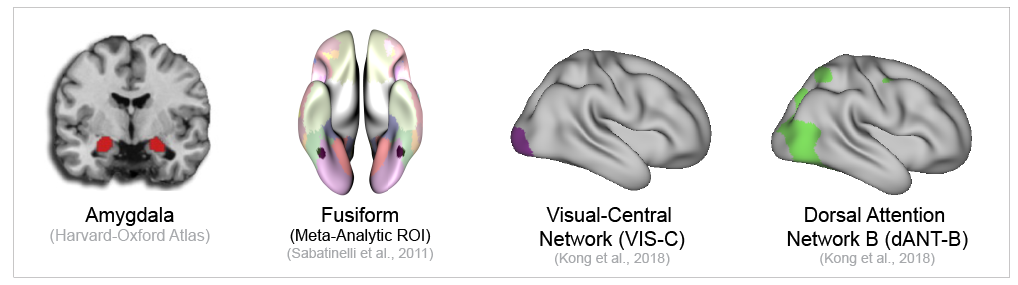
Sections:
Section 1. Is activity during emotion processing associated with stressful life events?
Section 2. Is activity during emotion processing associated with depression symptoms?
Section 3. Is activity during emotion processing associated with anxiety symptoms?
Section 1. Associations with Stressful Life Events
Stressful Life Events
Is activity during emotion processing associated with stressful life events?
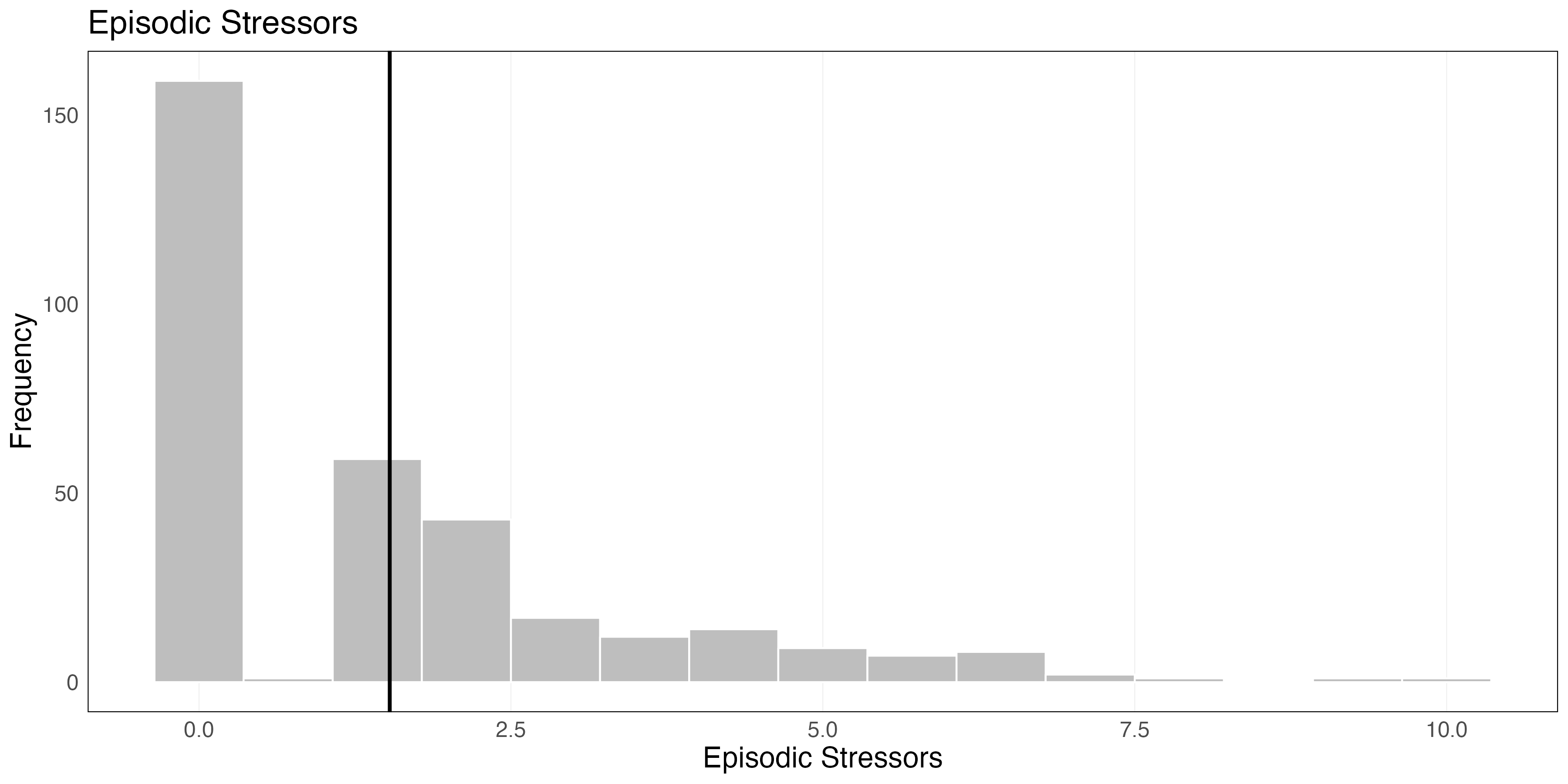
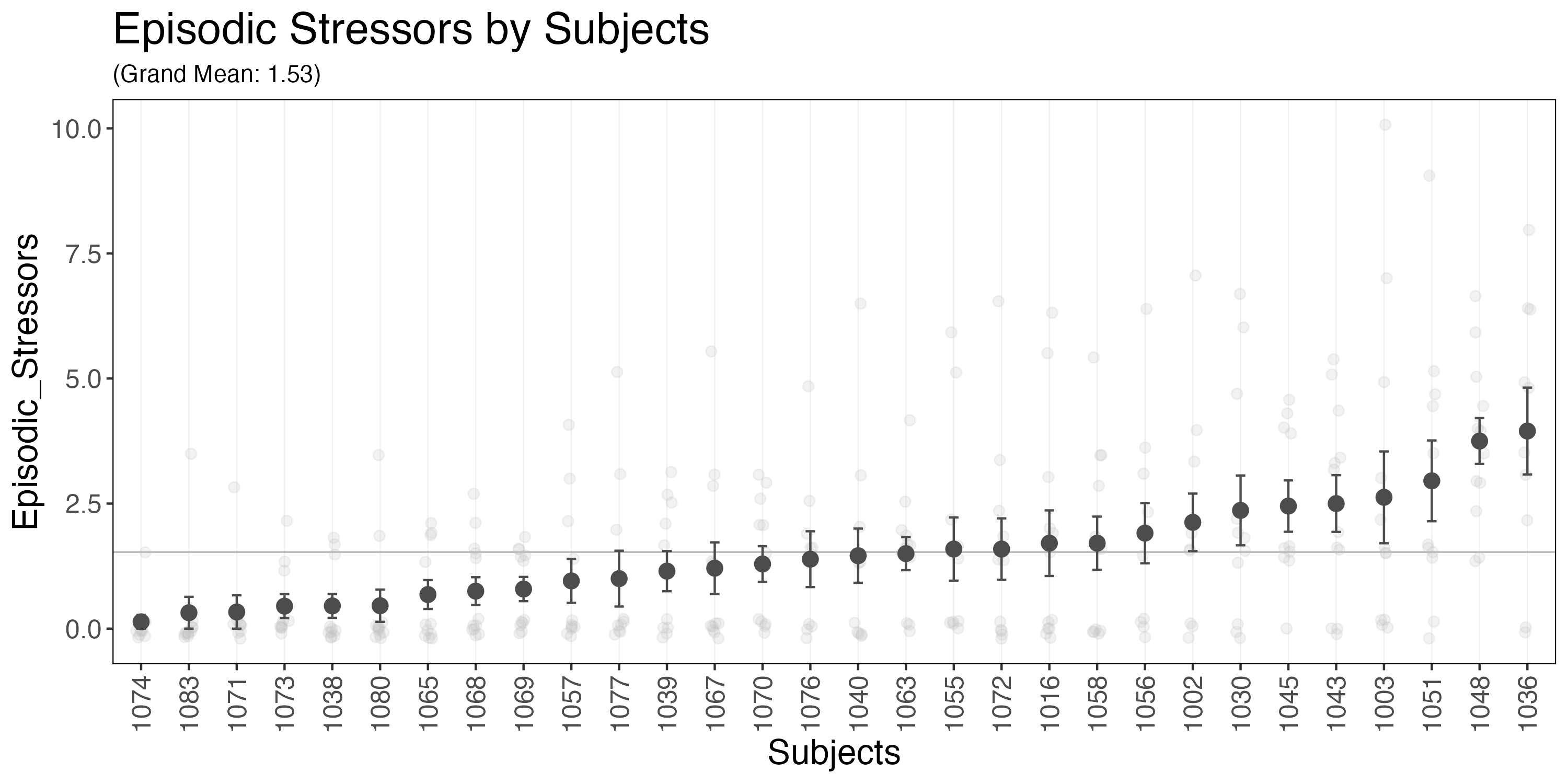
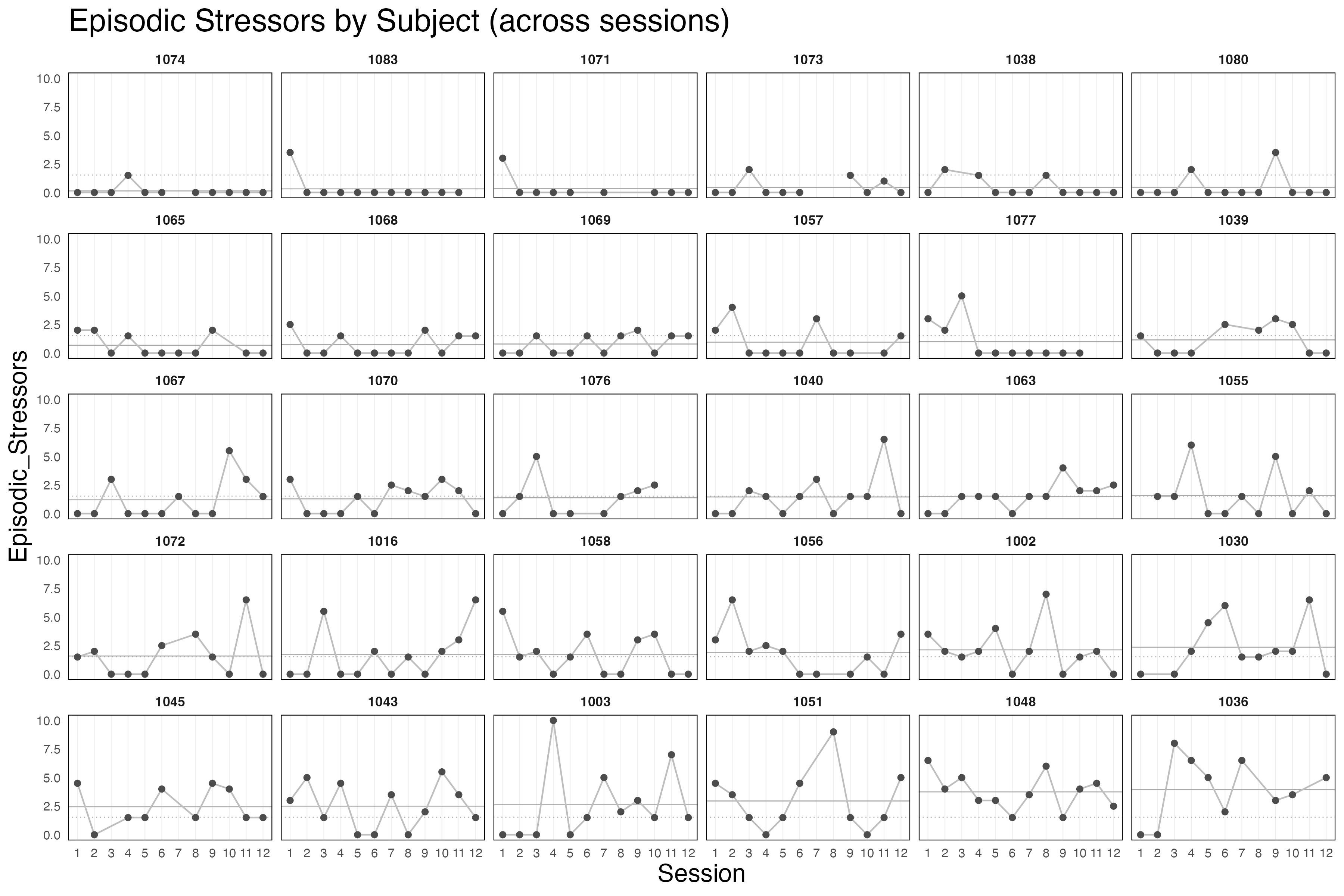
Associations of Stressful Life Events with Neural Activation
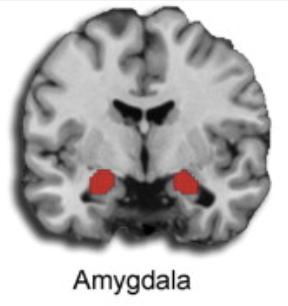
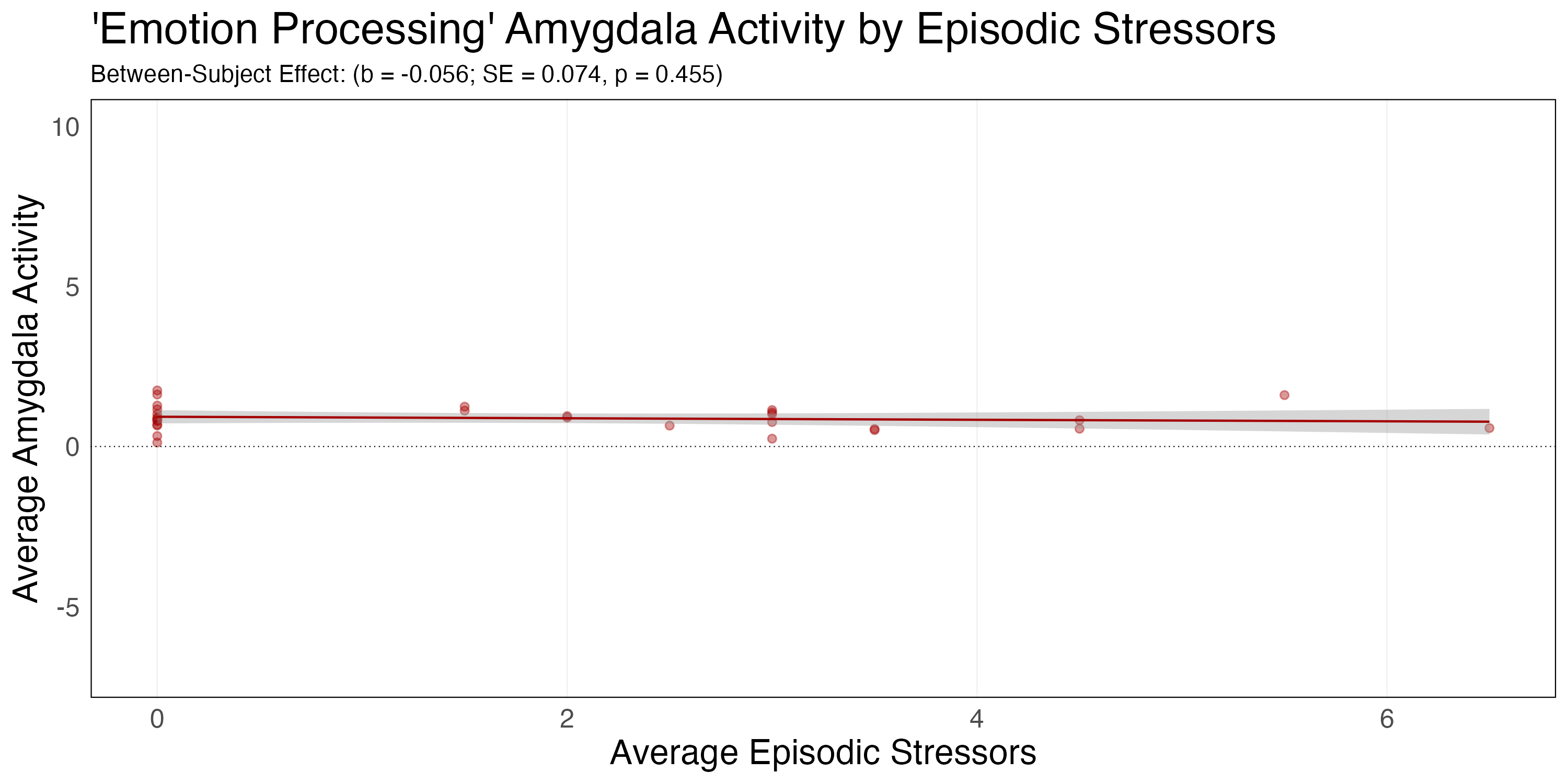
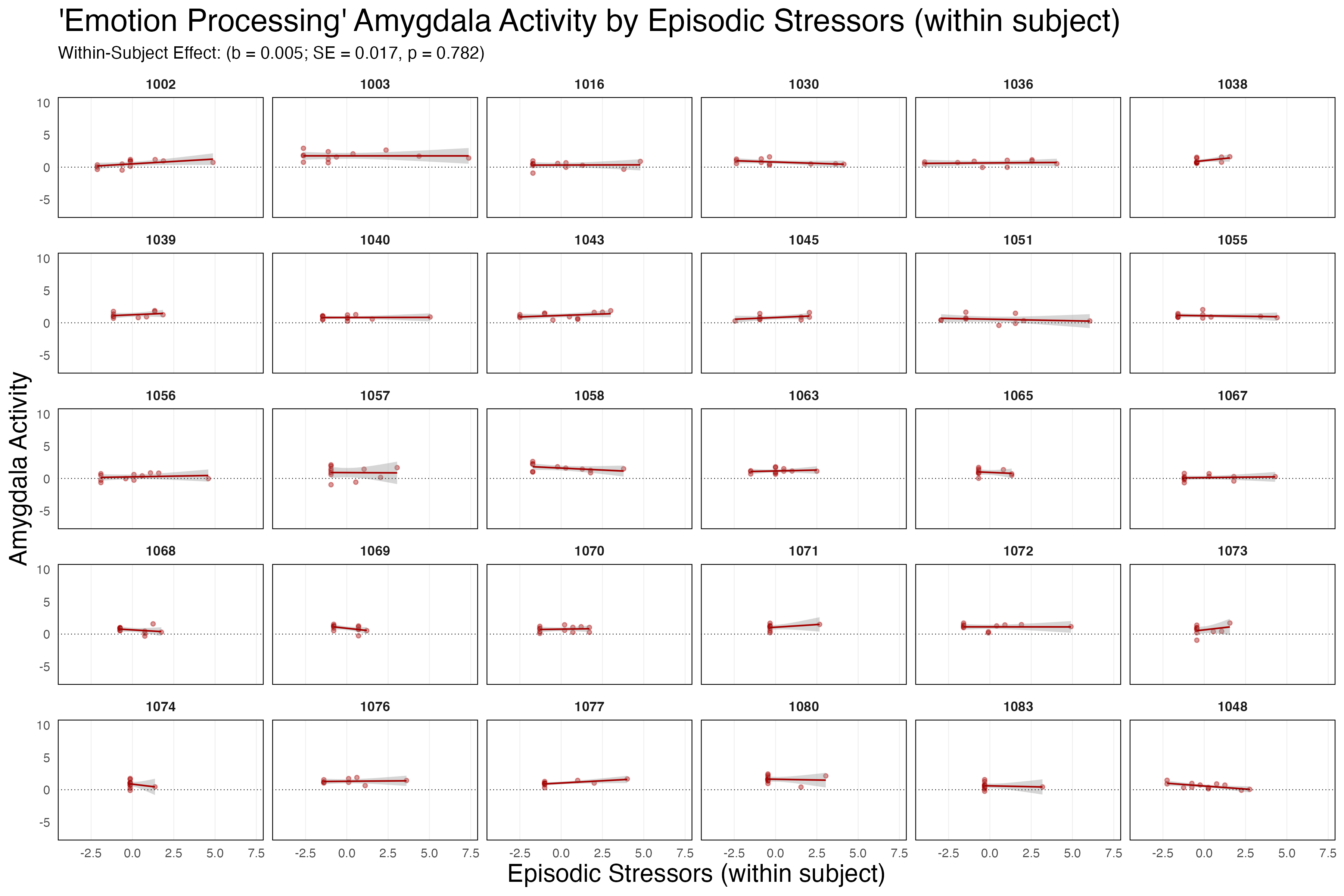

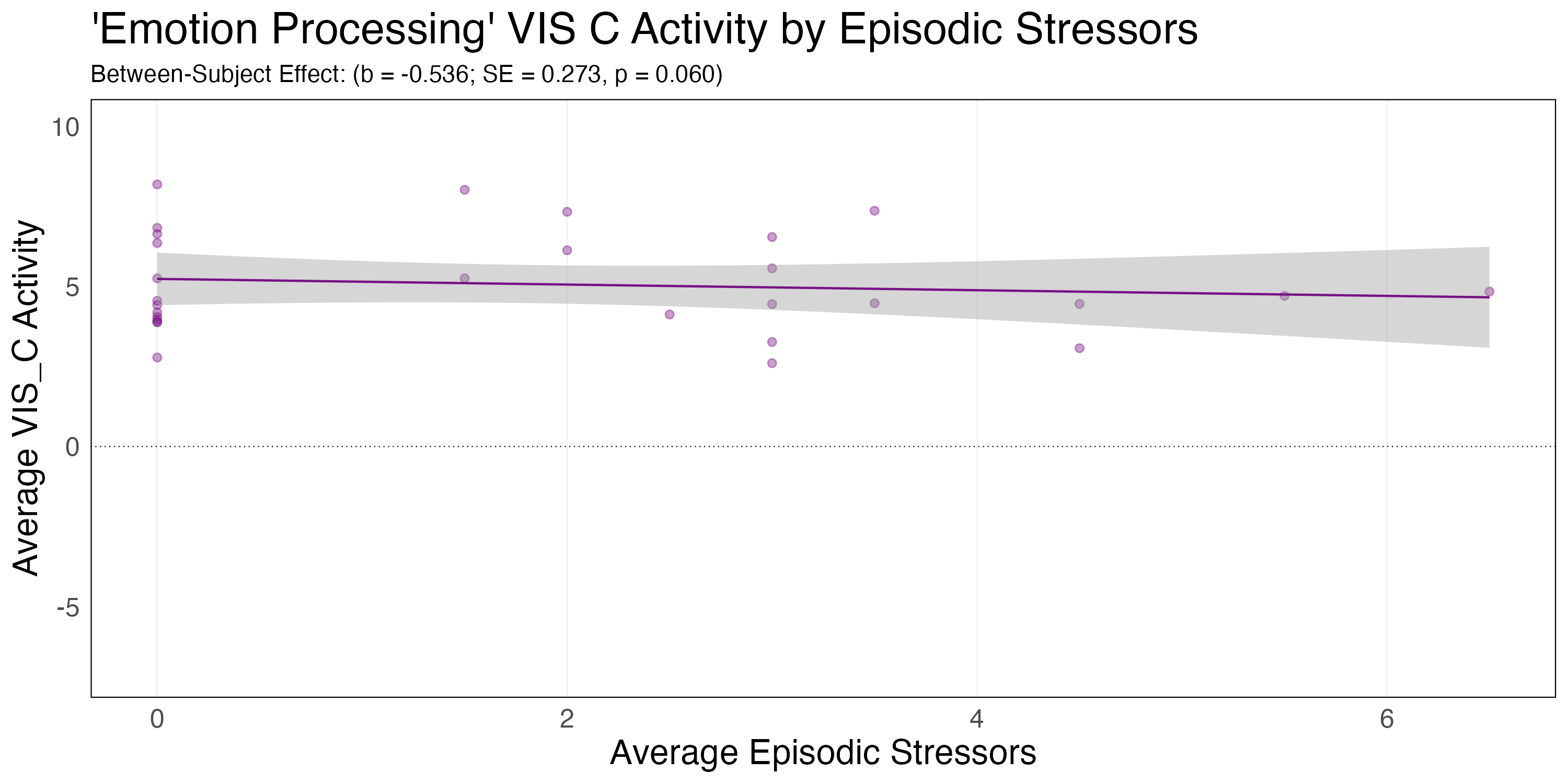
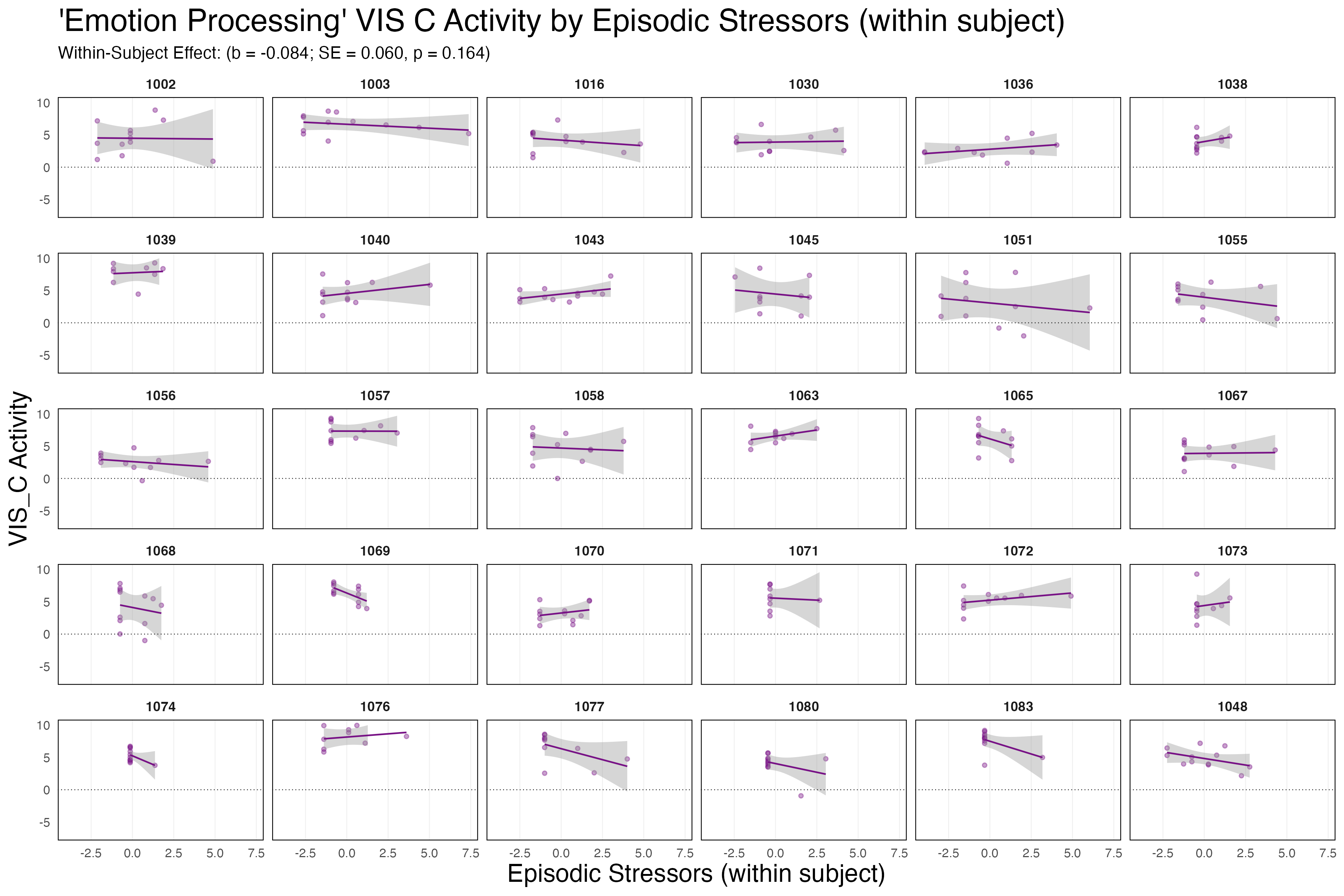

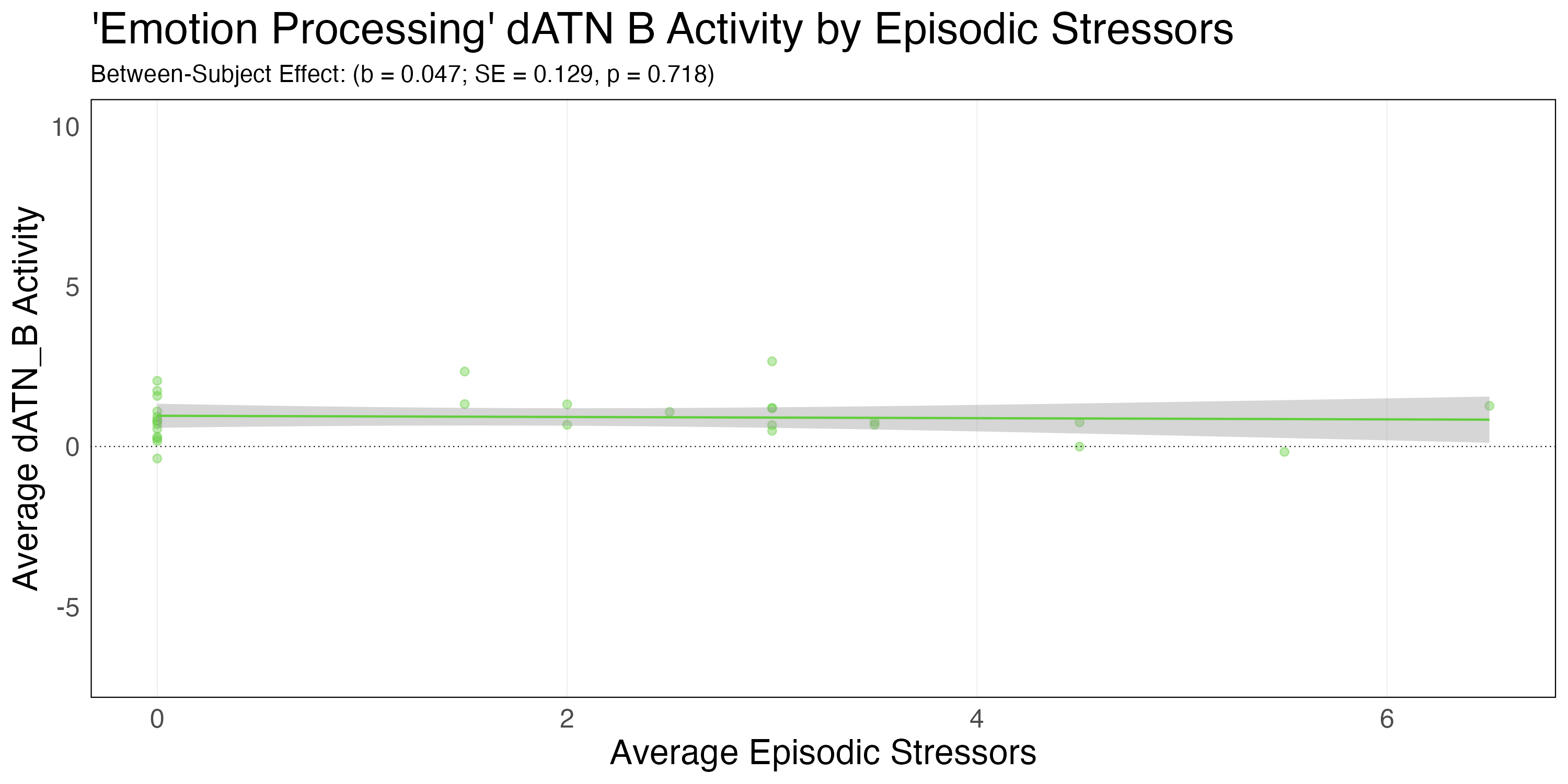
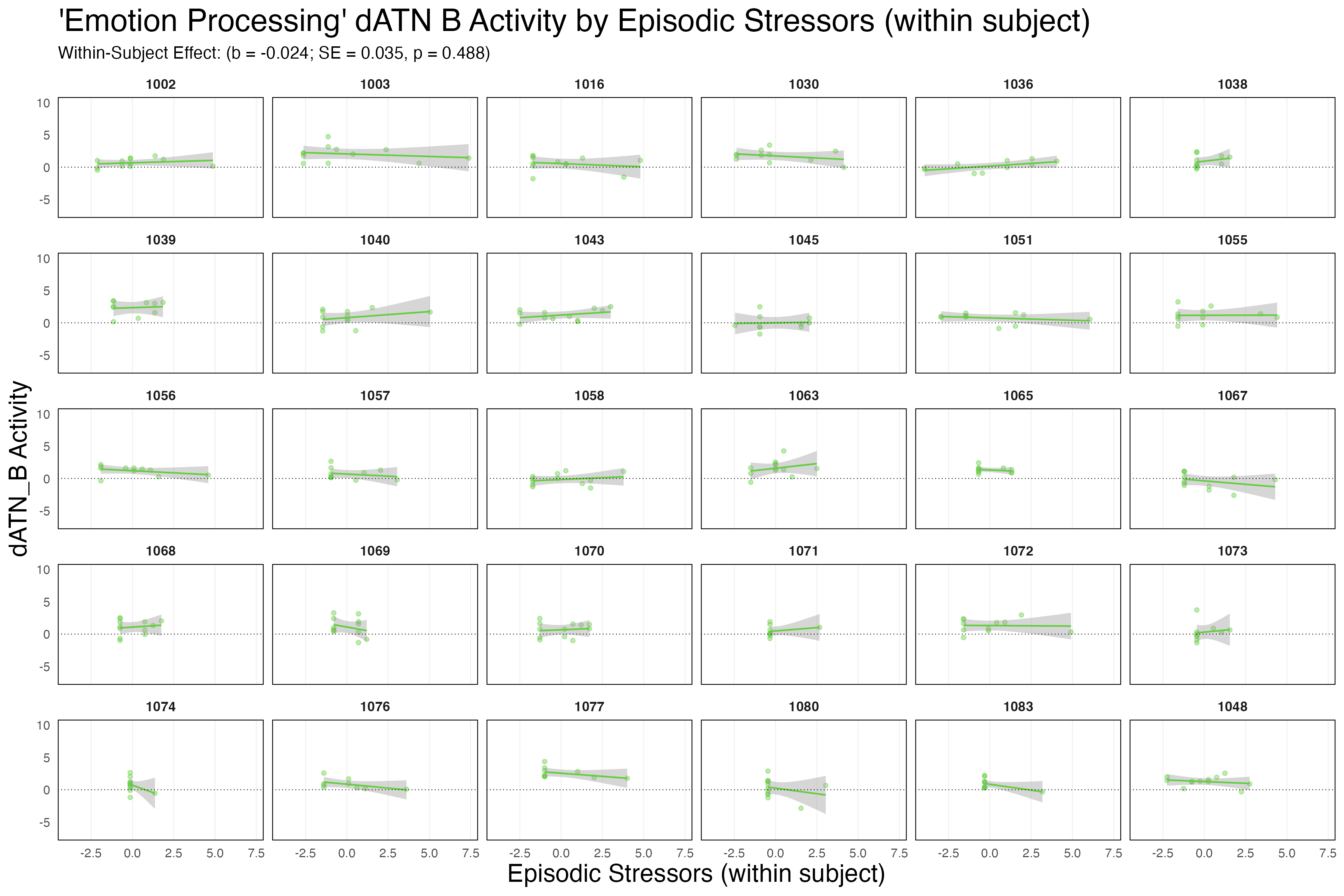
Amygdala. There was no significant association of stressful life events between-subjects with activity during emotion processing in the amygdala (b = -0.056, SE = 0.074, p = 0.455). Additionally, there was no significant associations with stressful life events within-subject (b = 0.005, SE = 0.017, p = 0.78).
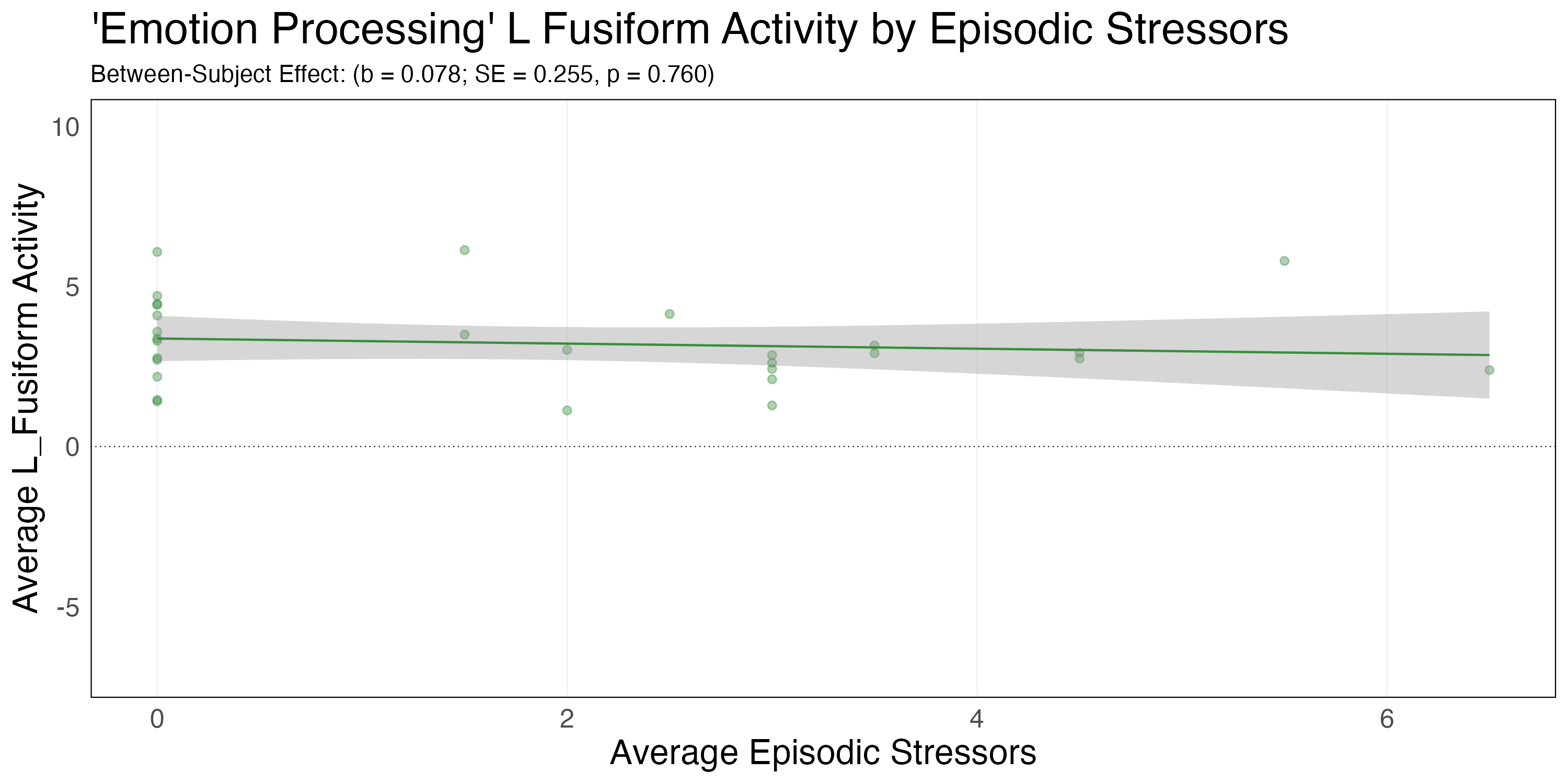
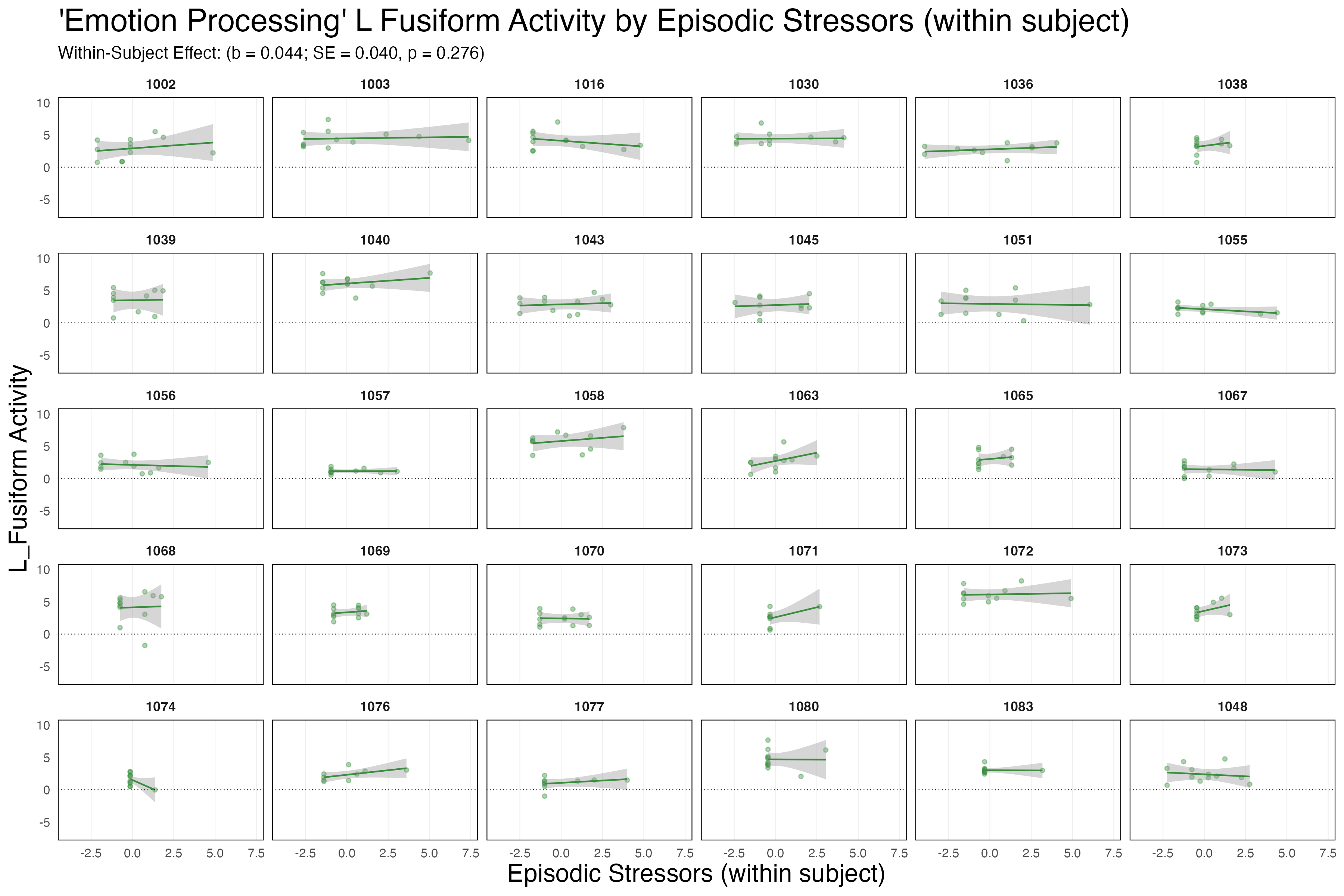
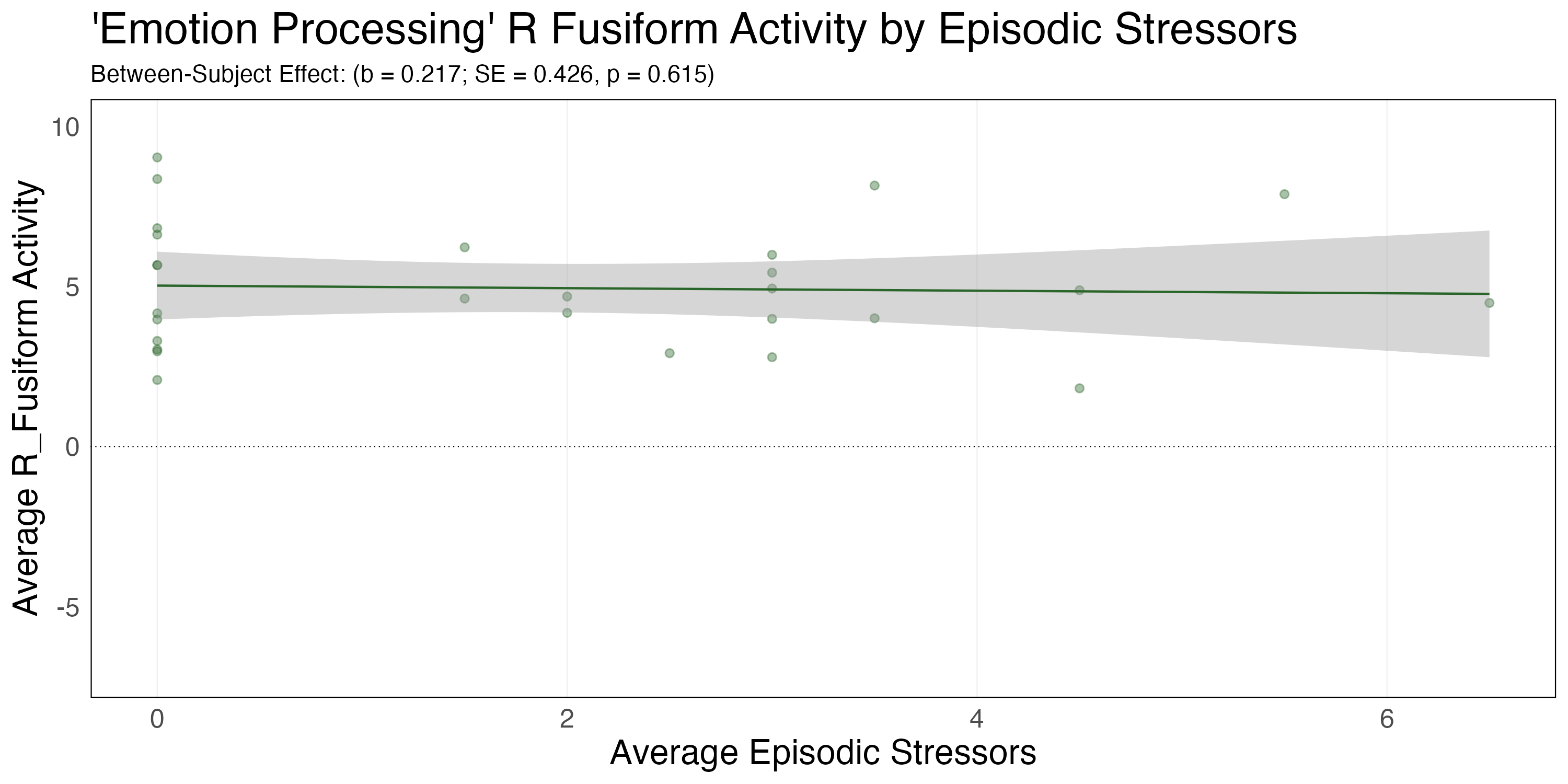
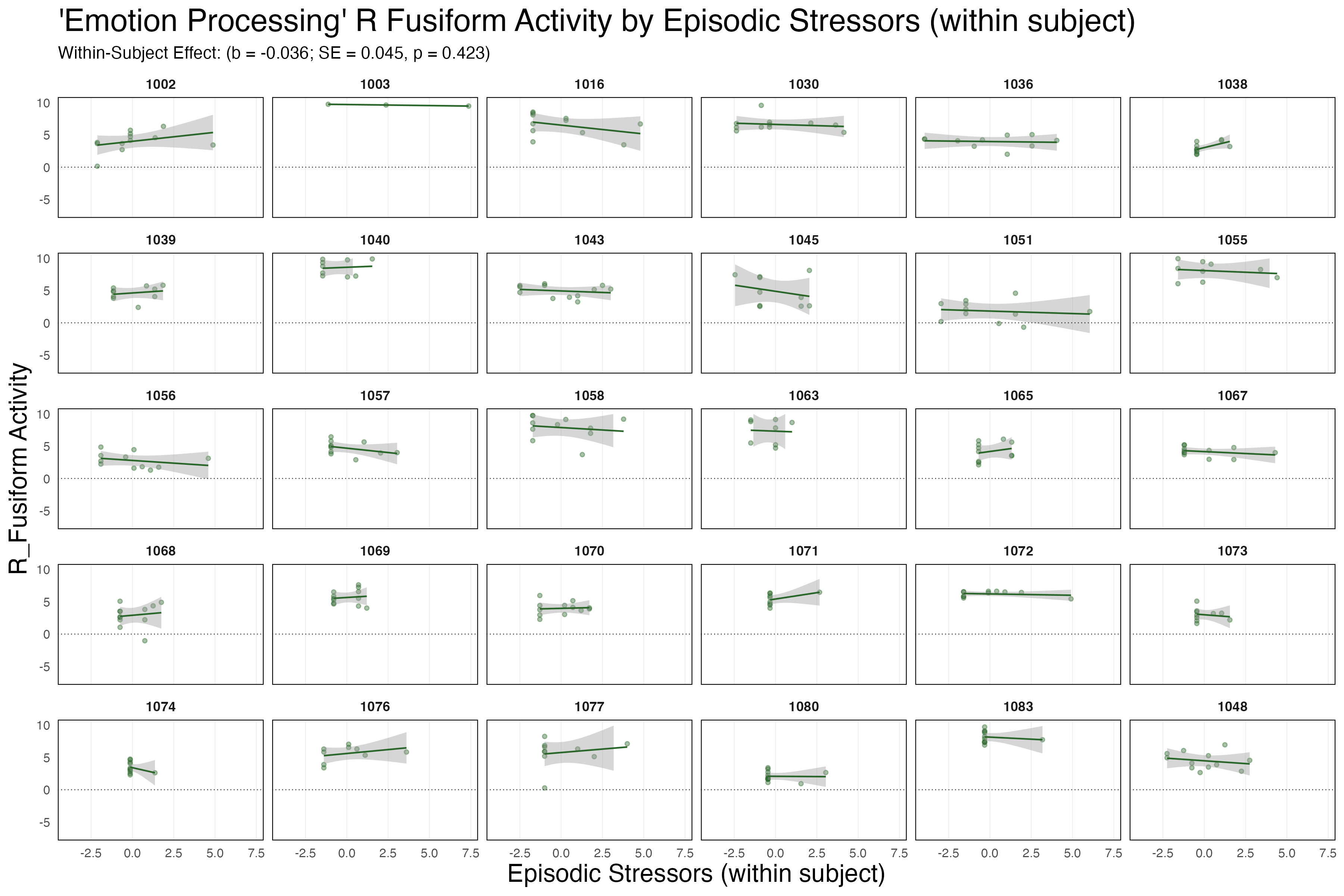
Left and Right Fusiform. There was no significant association of stressful life events between-subjects with activity during emotion processing in the right or left fusiform (right fusiform: b = 0.22 , SE = 0.43 , p = 0.62, left fusiform: b = 0.078, SE = 0.26, p = 0.76). Additionally, there were no significant within-subject stressful life events associations with activity during emotion processing in the right or left fusiform (right fusiform: b = -0.036, SE = 0.045, p = 0.42, Left Fusiform: b = 0.044, SE = 0.040, p = 0.28).
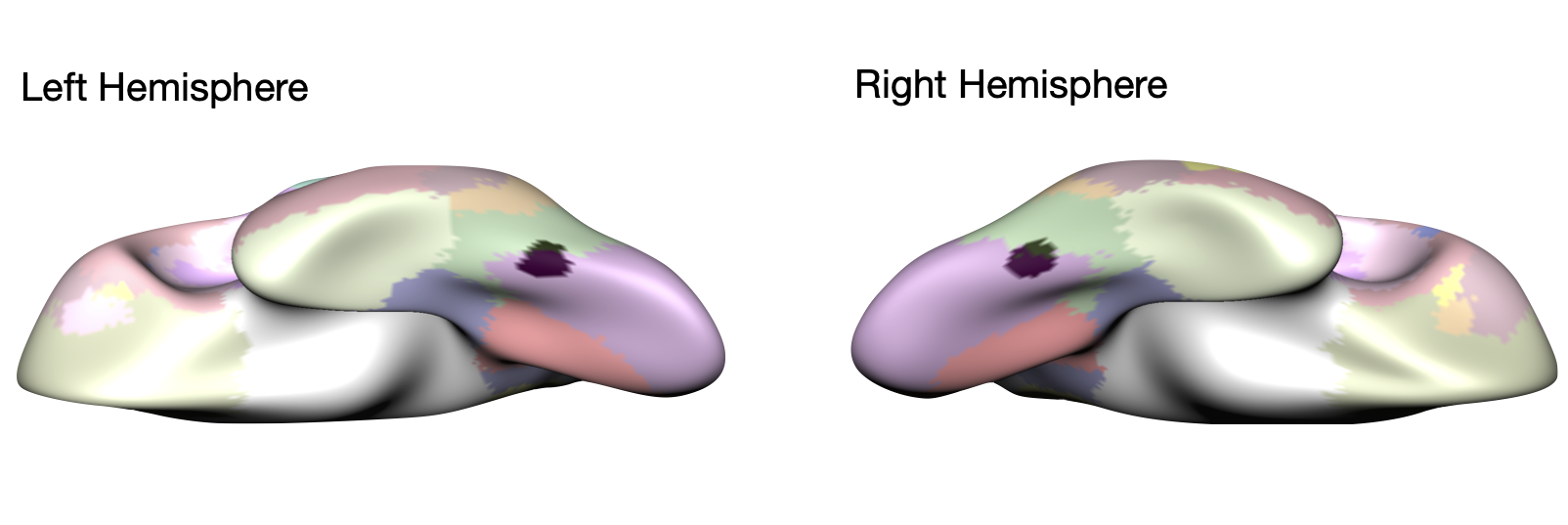
Visual-Central Network (VIS-C). There was no significant association of stressful life events between-subject with activity during emotion processing in the visual-central network (VIS-C) (b = -0.54, SE = 0.27, p = 0.060). Additionally, there was no significant association with stressful life events within-subject (VIS-C: b = -0.084, SE = 0.060, p = 0.16).
Dorsal Attention Network B (dATN-B). There was no significant association of stressful life events between-subject with activity during emotion processing in dorsal attention network B (dATN-B) (b = 0.047, SE = 0.13, p = 0.72). Additionally, there was no significant association with stressful life events within-subject (b = -0.024, SE = 0.035, p = 0.488).
Section 2. Associations with Depression Symptoms
Is activity during emotion processing associated with depression symptoms?
Depression Symptoms
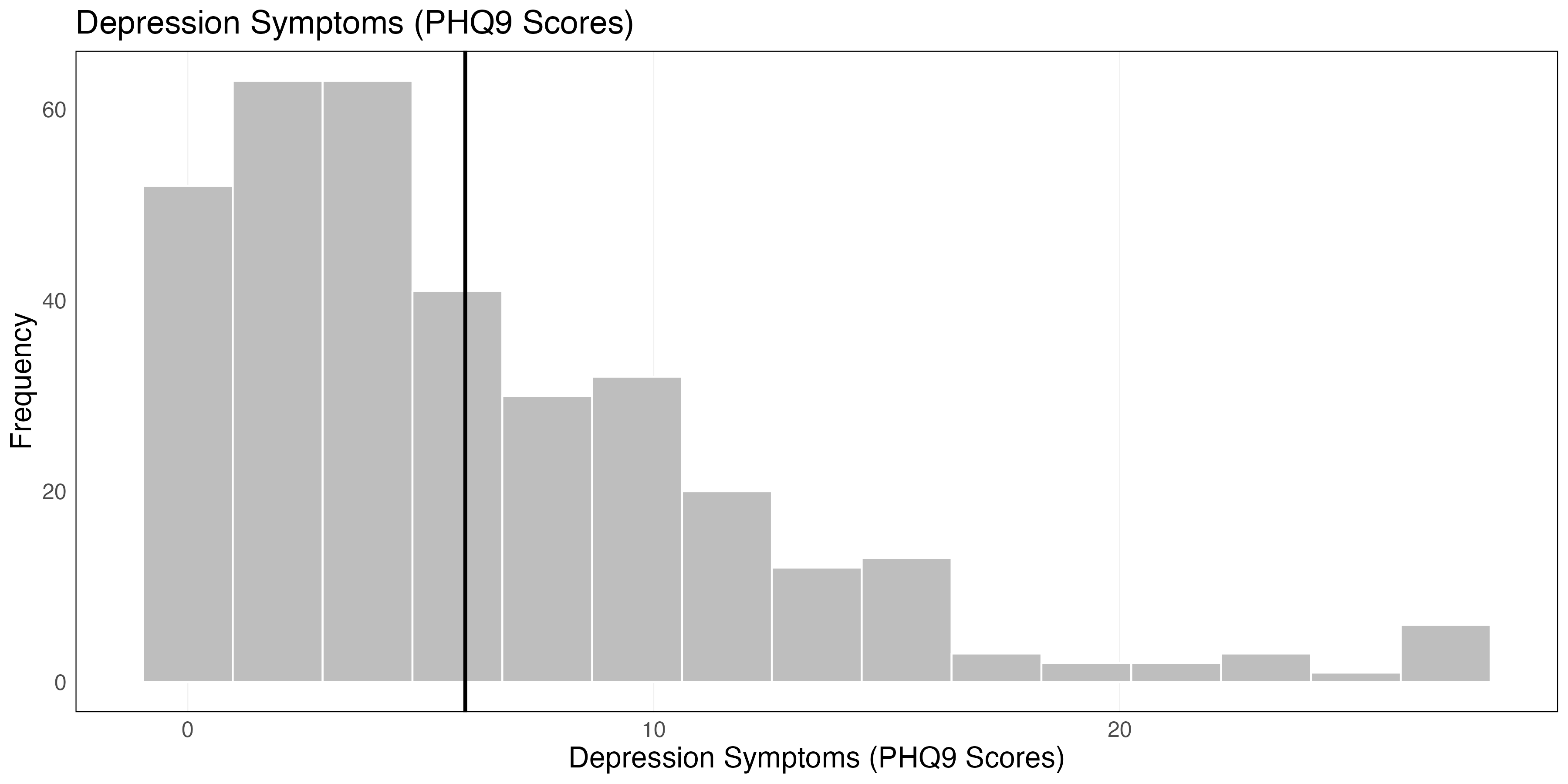
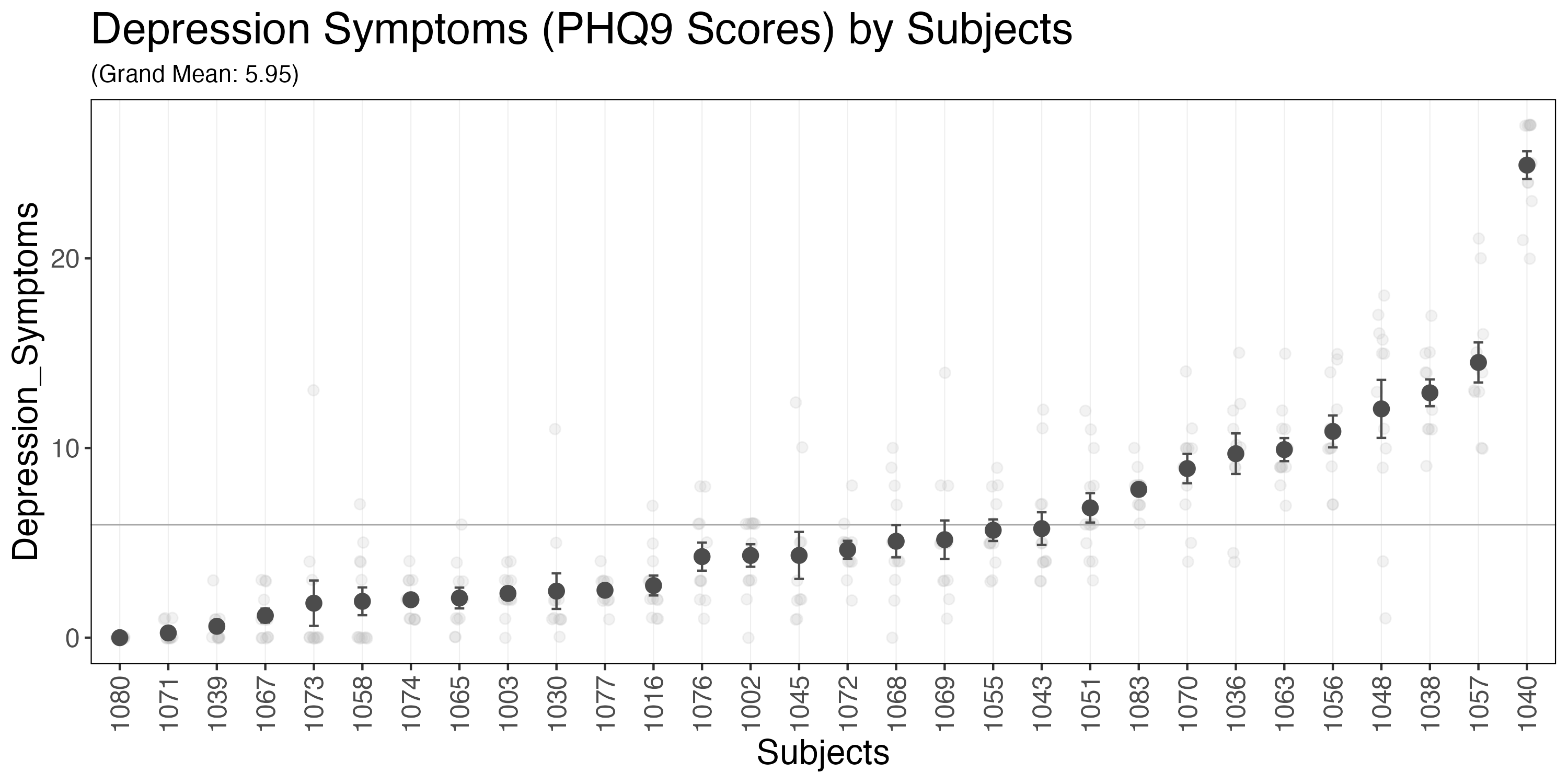
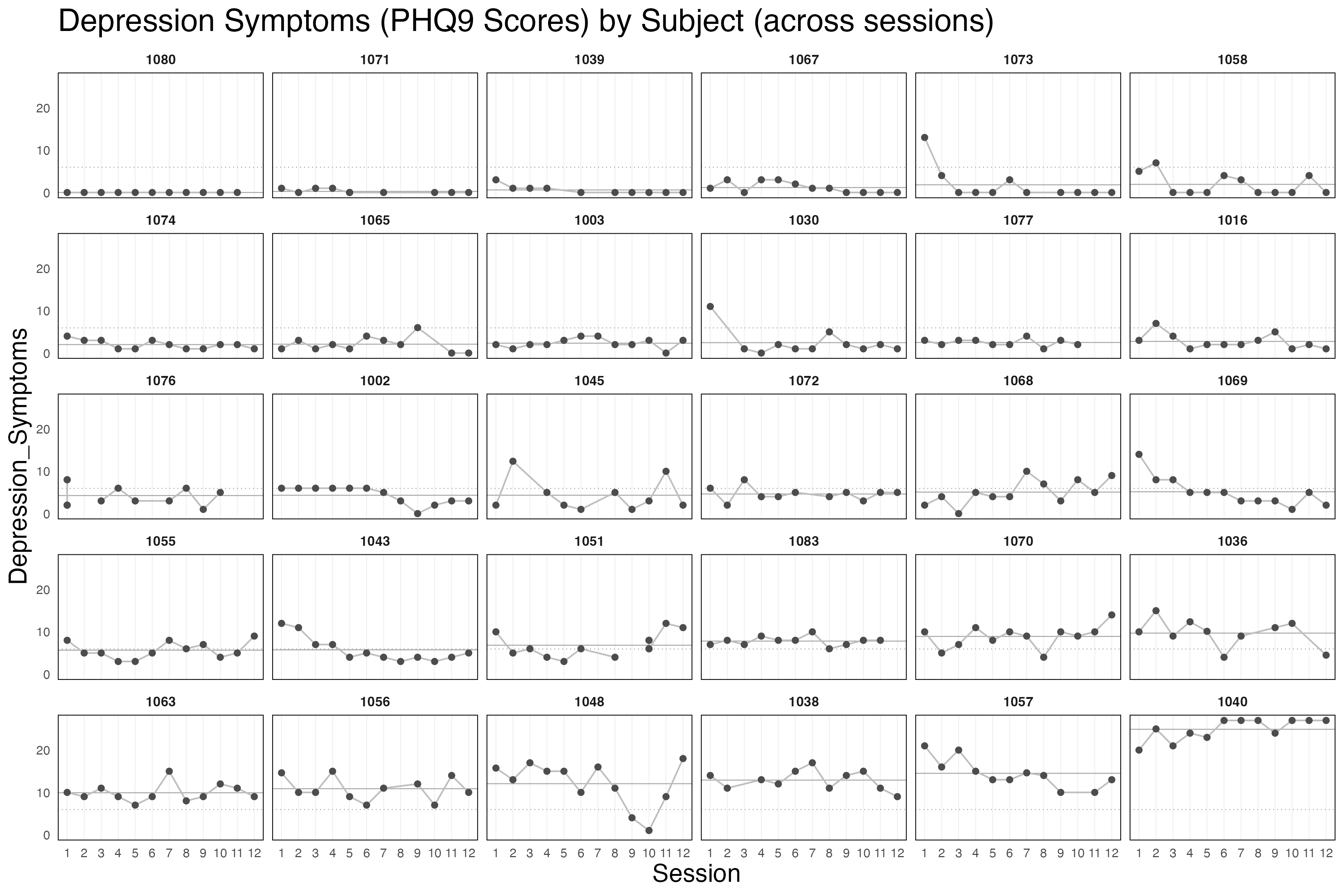
Associations of Depression Symptoms with Neural Activation
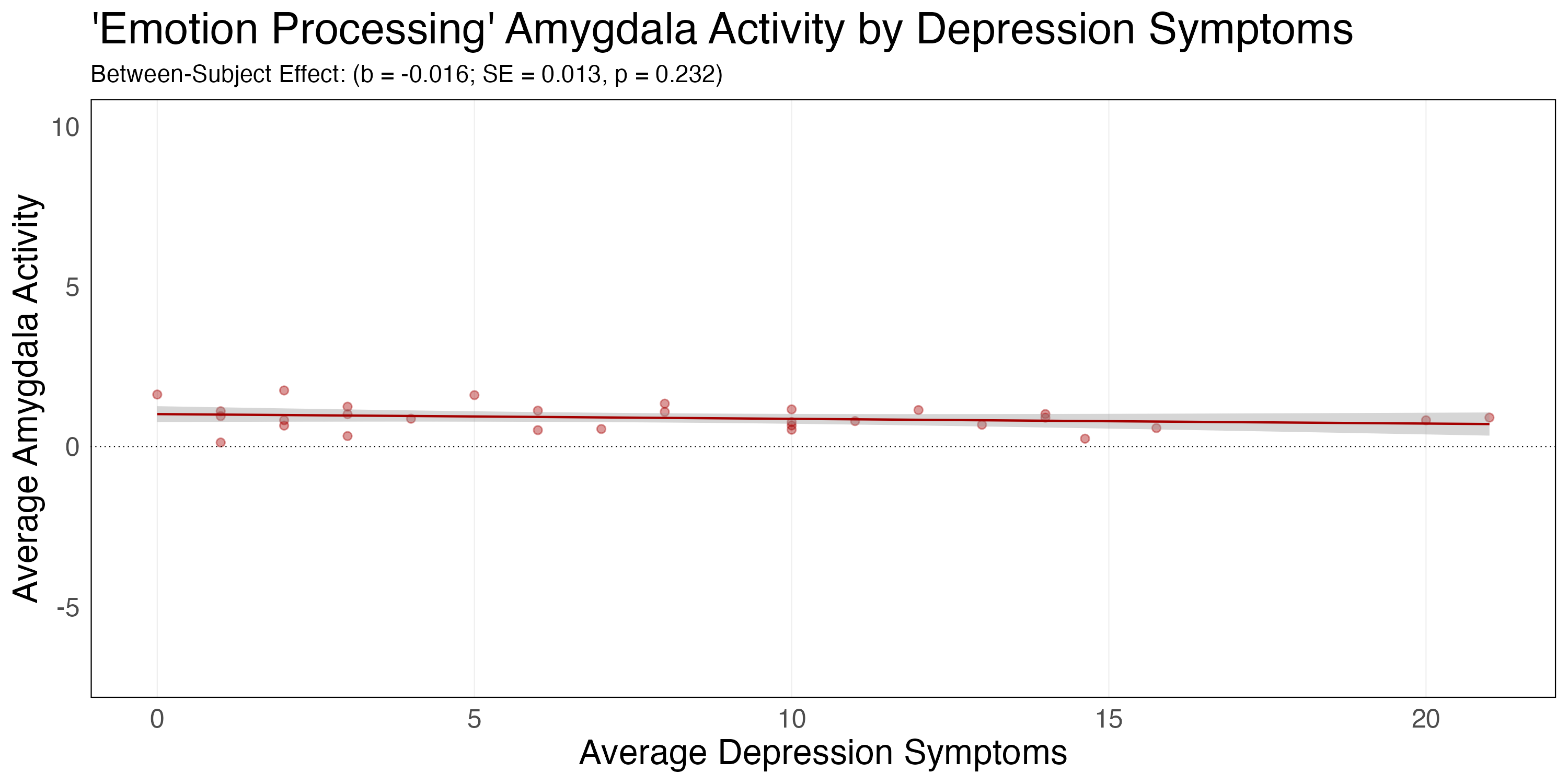
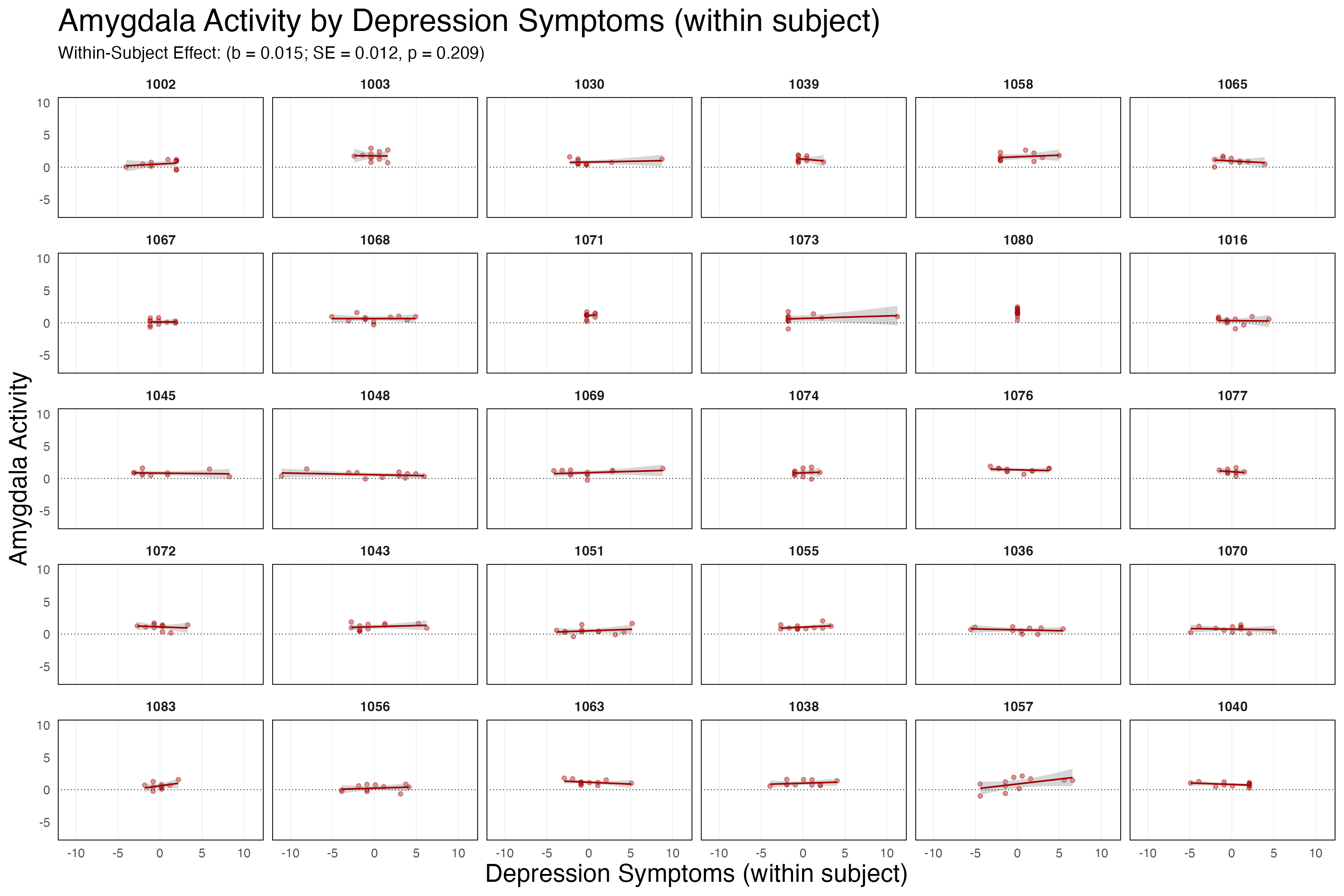
Amygdala. There was no significant association of depression symptoms between-subjects with activity during emotion processing in the amygdala (b = -0.016, SE = 0.013, p = 0.22). Additionally, there were no significant association with depression symptoms within-subject (b = 0.015, SE = 0.012, p = 0.21).
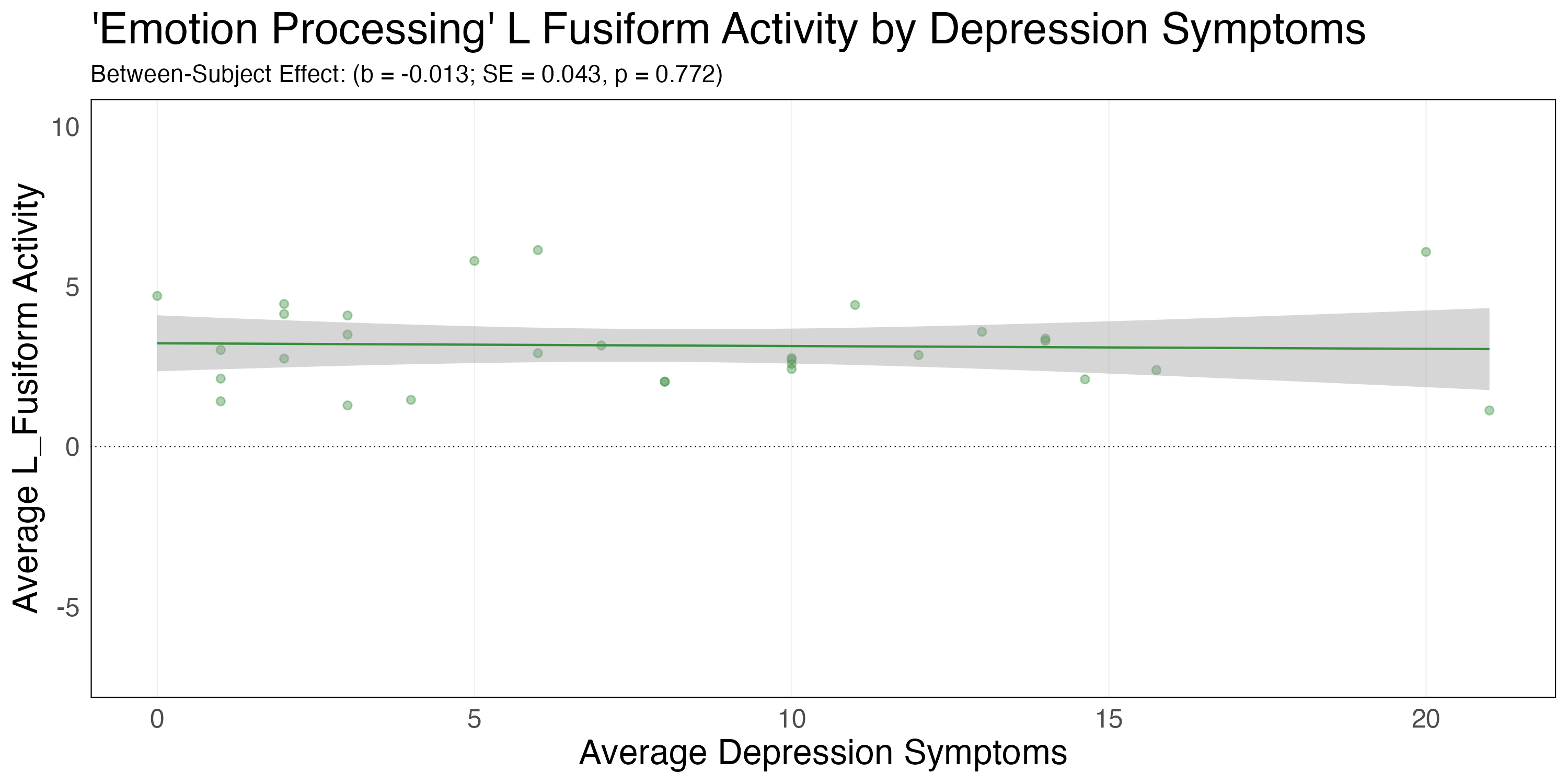
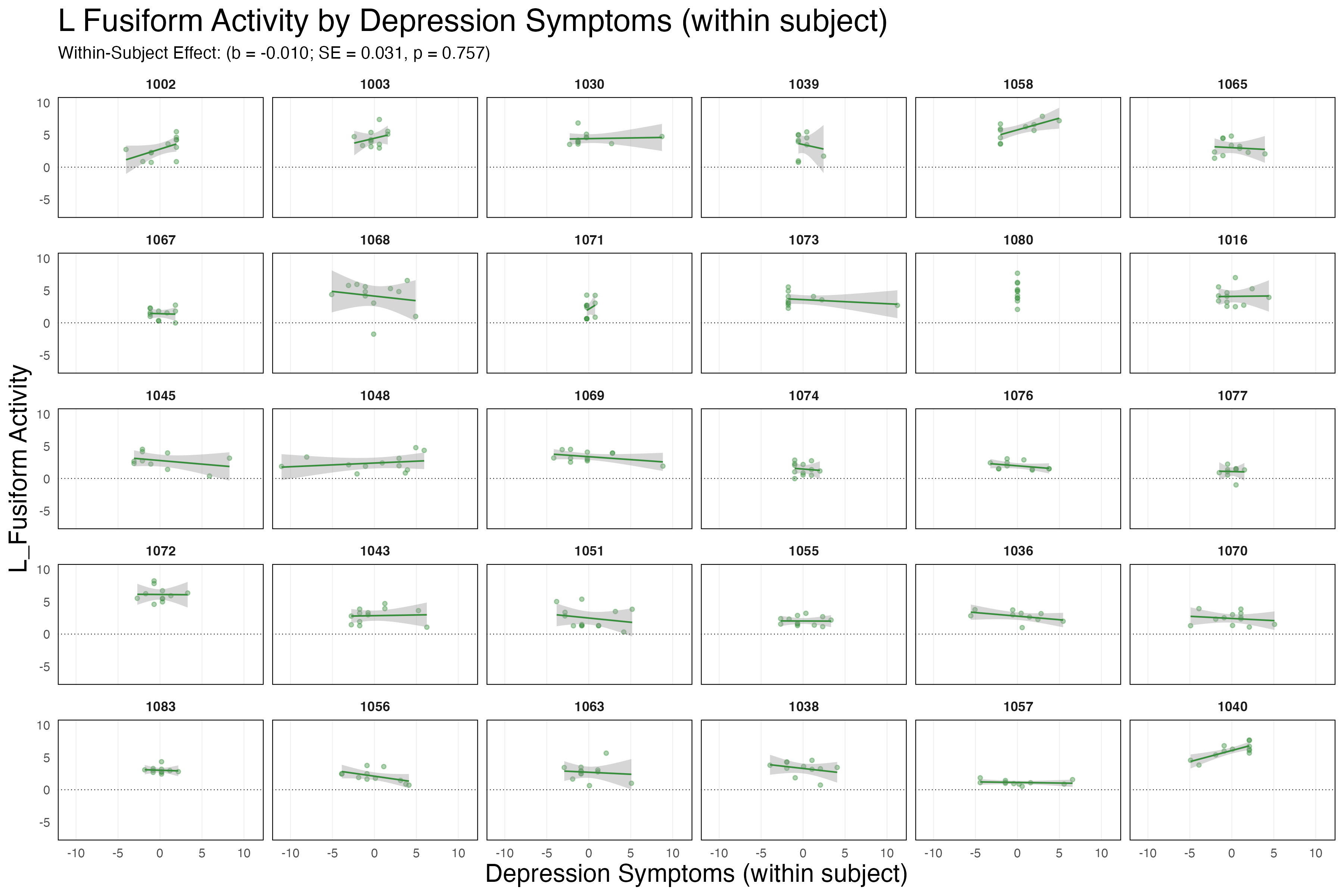
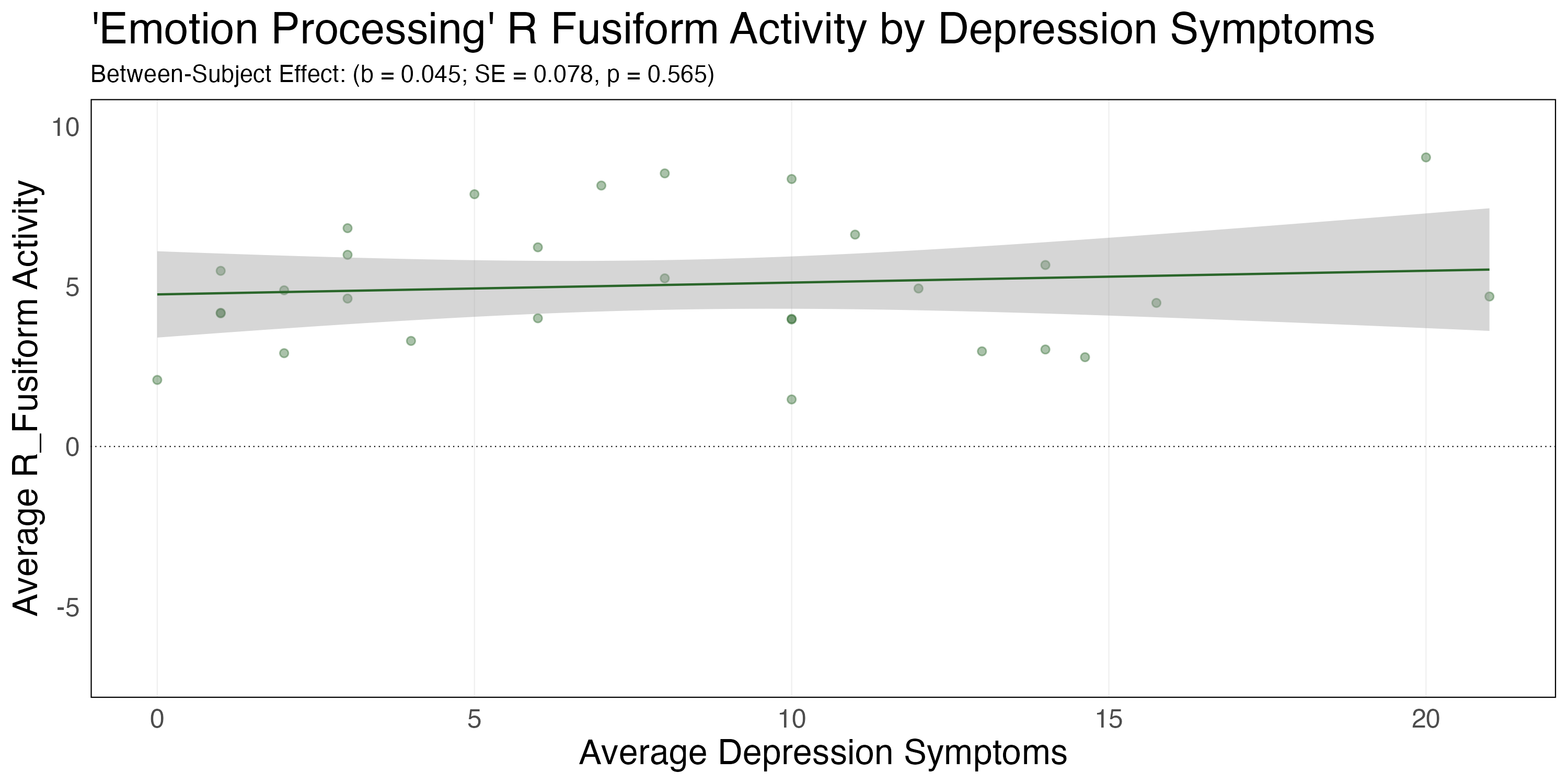
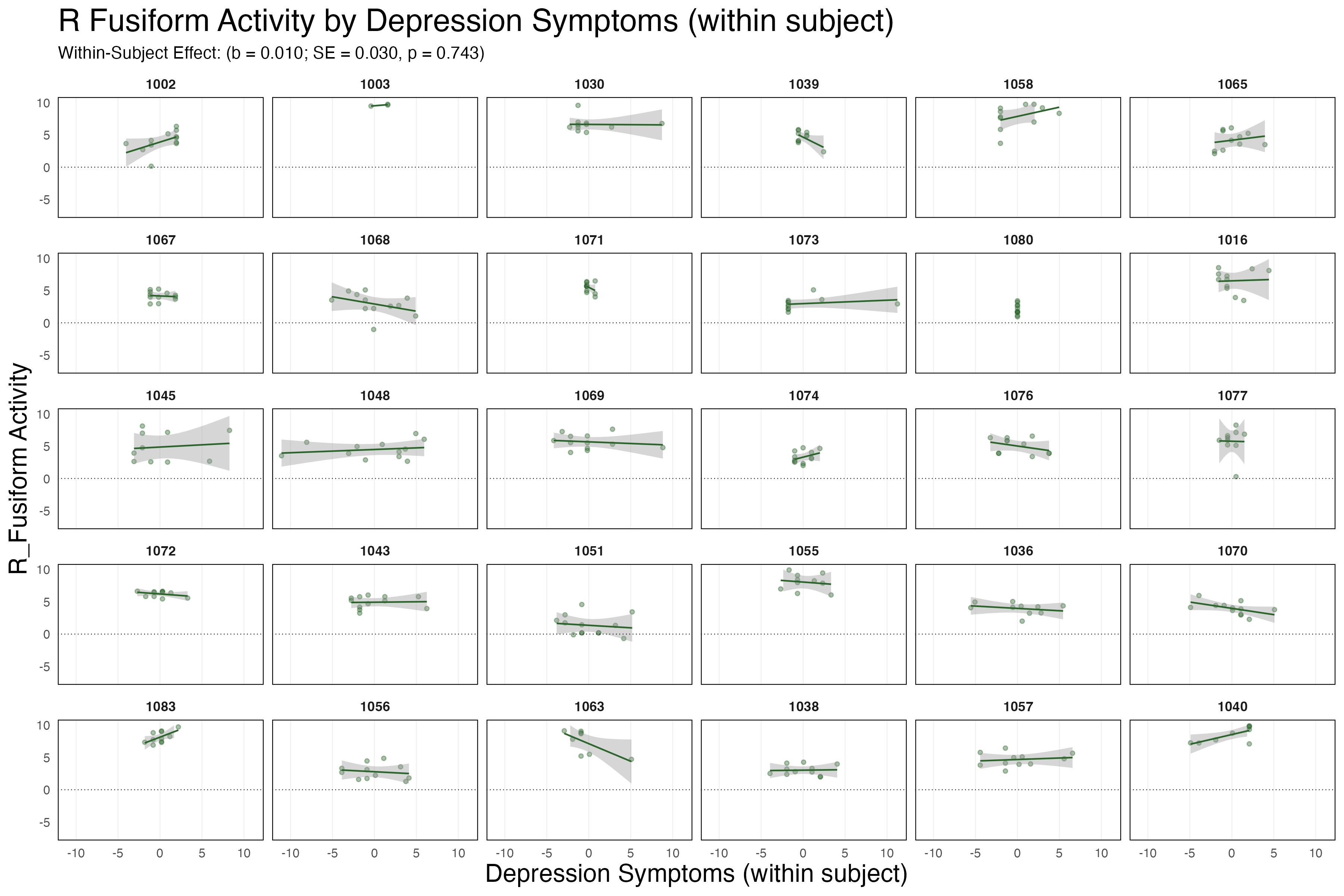
Left and Right Fusiform. There was no significant association of between-subject depression symptoms with activity during emotion processing in the left or right fusiform (left fusiform: b = -0.013, SE = 0.043, p = 0.77; right fusiform: b = 0.045 , SE = 0.078 , p = 0.57). Additionally, there were no significant within-subject depression symptoms associations with activity during emotion processing within the left or right fusiform (left fusiform: b = -0.010, SE = 0.031, p = 0.757; right fusiform: b = 0.010, SE = 0.030, p = 0.73).
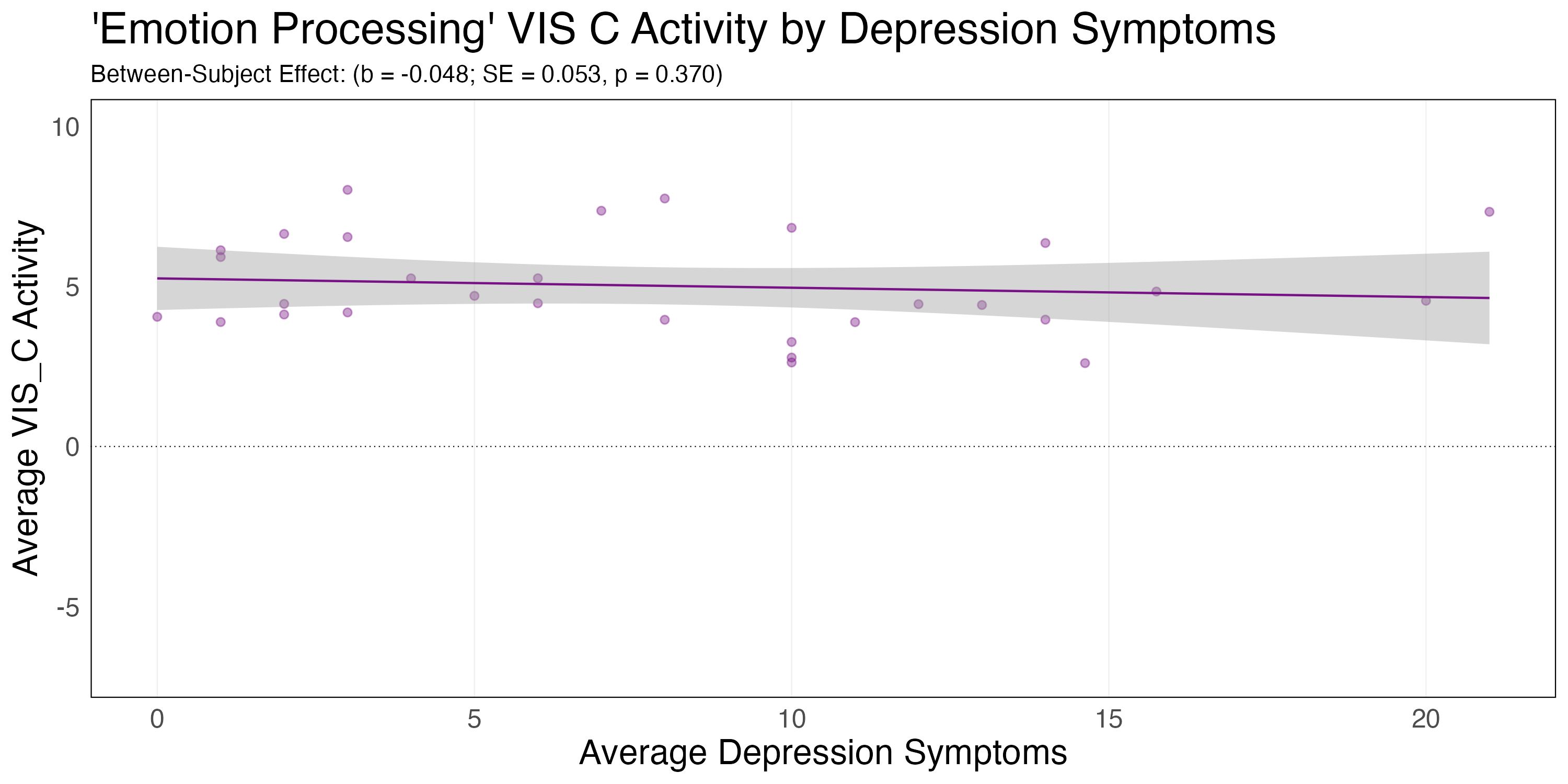
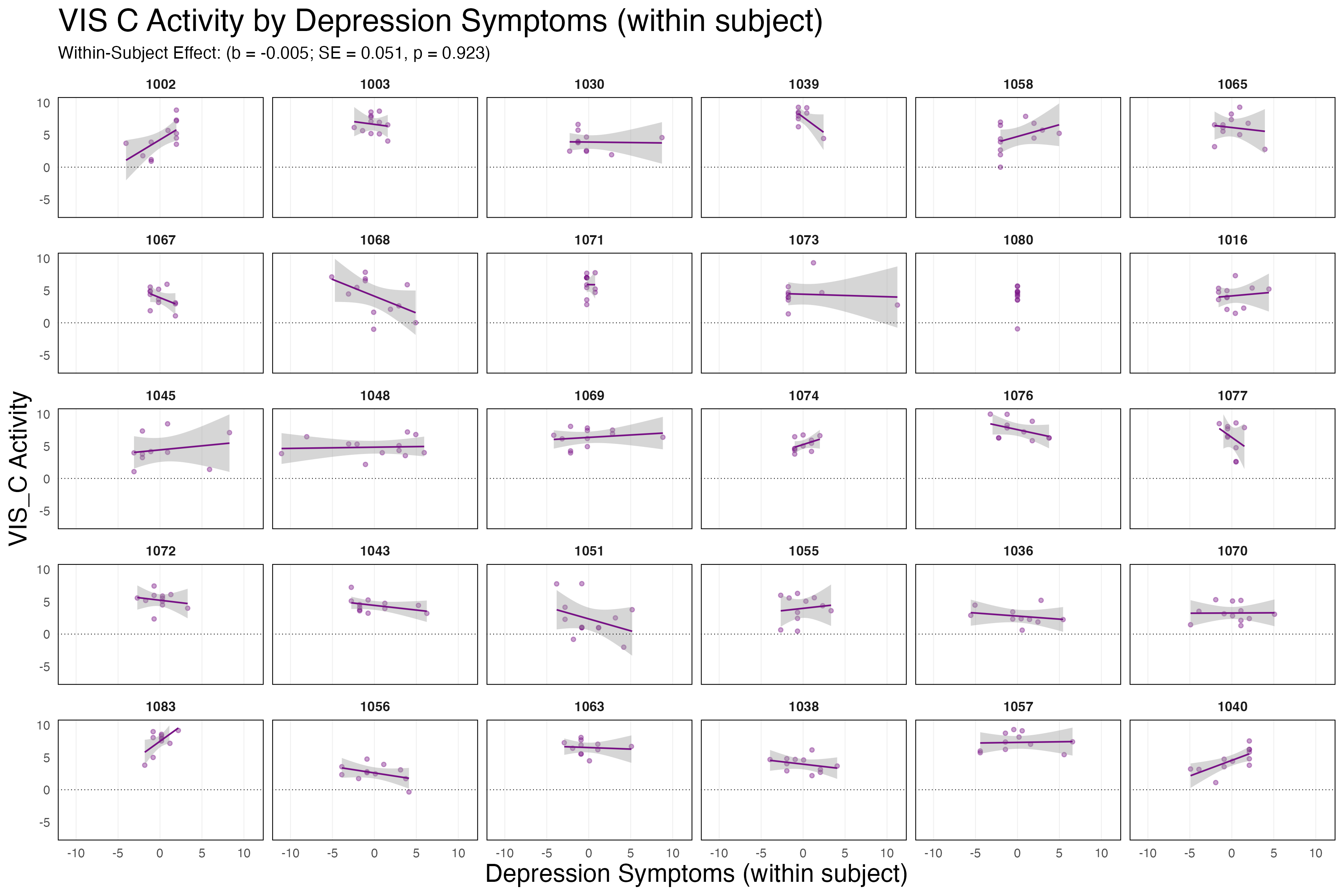
Visual-Central Network (VIS-C). There was no significant association of between-subject depression symptoms with activity during emotion processing in the visual-central network (VIS-C) (b = -0.048, SE = 0.053, p = 0.37). Additionally, there was no significant association with depression symptoms within-subject (VIS-C: b = -0.005, SE = 0.051, p = 0.92).
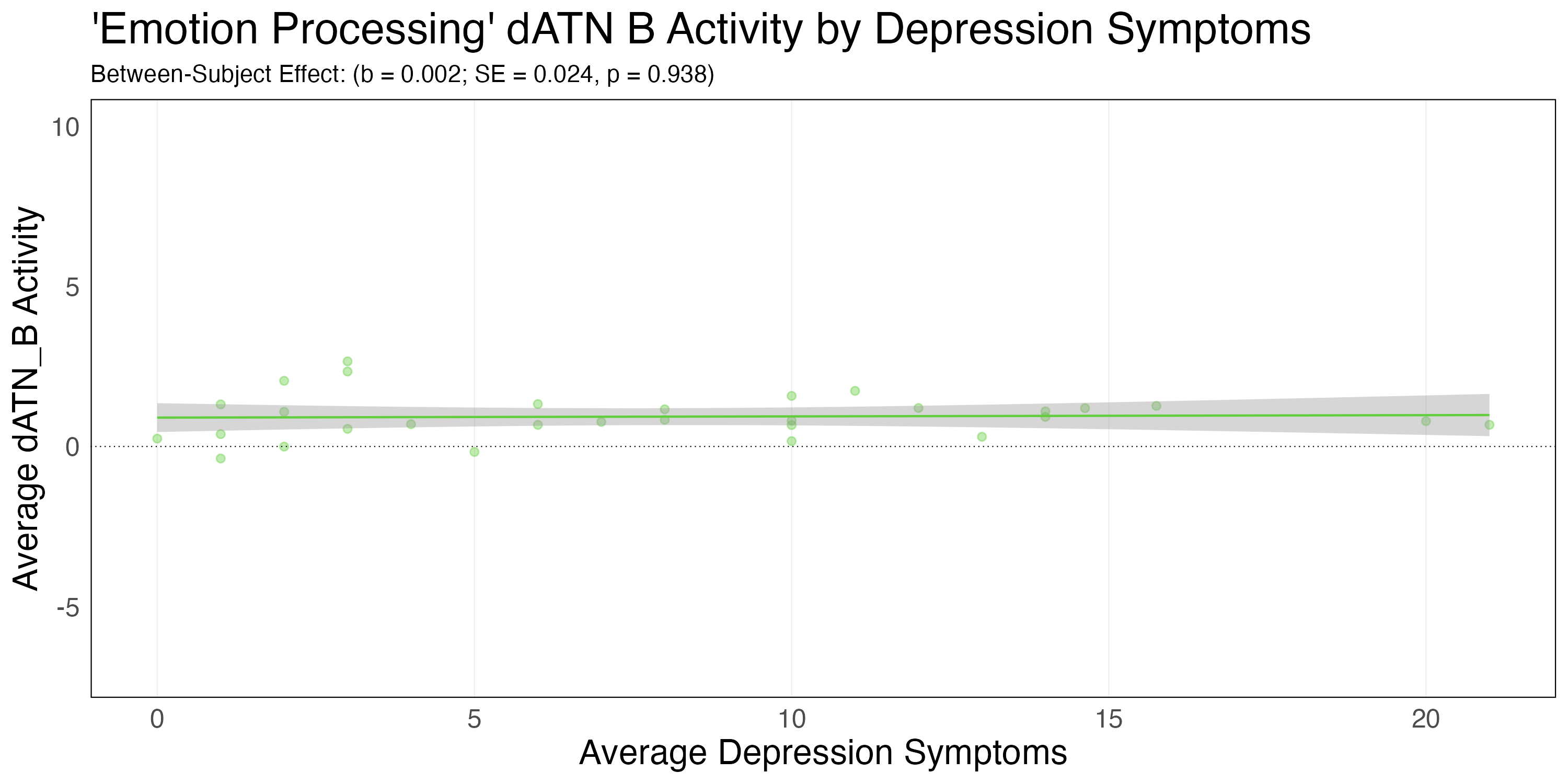
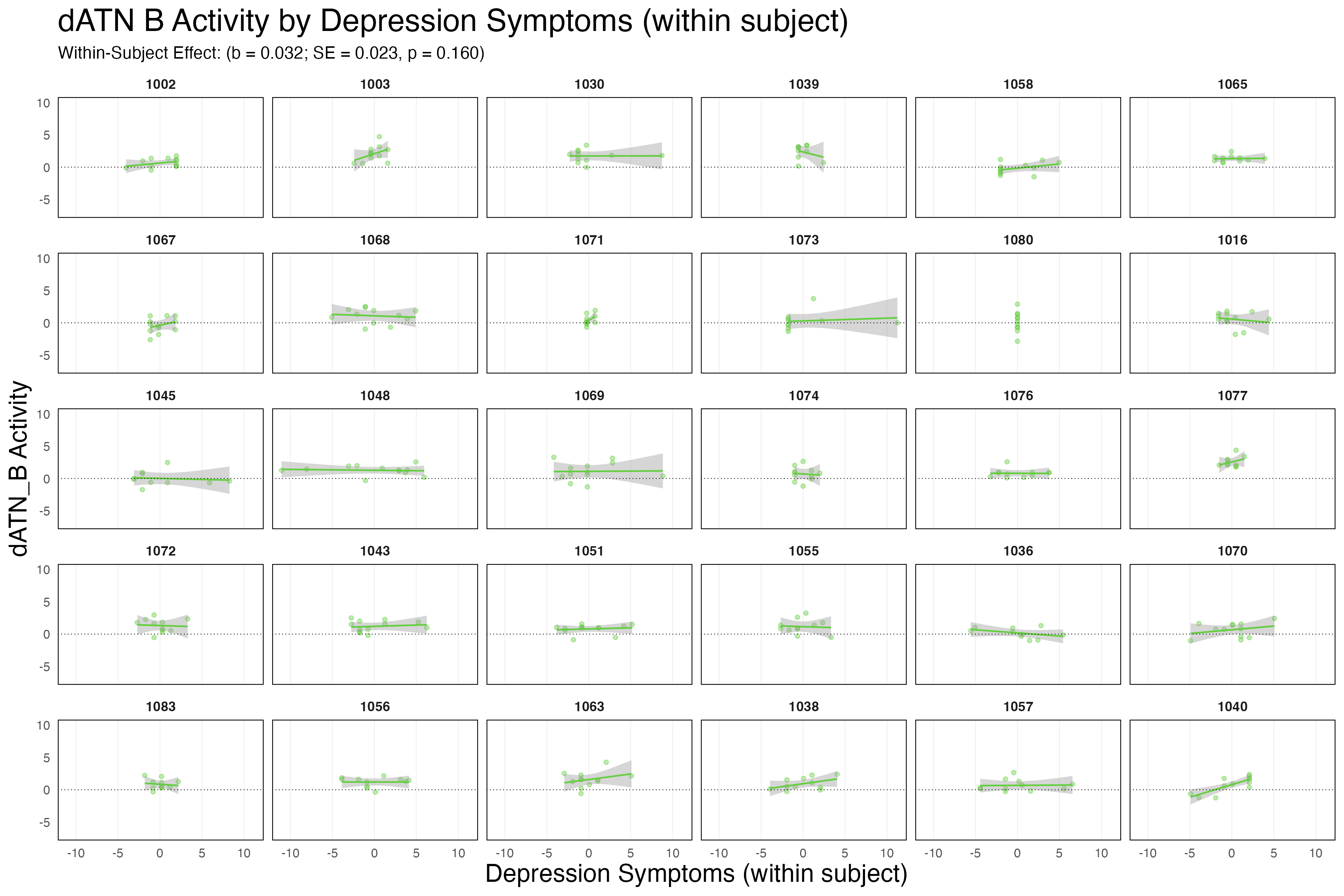
Dorsal Attention Network B (dATN-B). There was no significant association of between-subject depression symptoms with activity during emotion processing in dorsal attention network B (dATN-B) (b = 0.002, SE = 0.024, p = 0.94). Additionally, there was no significant association with depression symptoms within-subject (b = 0.032, SE = 0.023, p = 0.16).
Section 3. Associations with Anxiety Symptoms
Is activity during emotion processing associated with anxiety symptoms?
Anxiety Symptoms
Associations of Anxiety Symptoms with Neural Activation
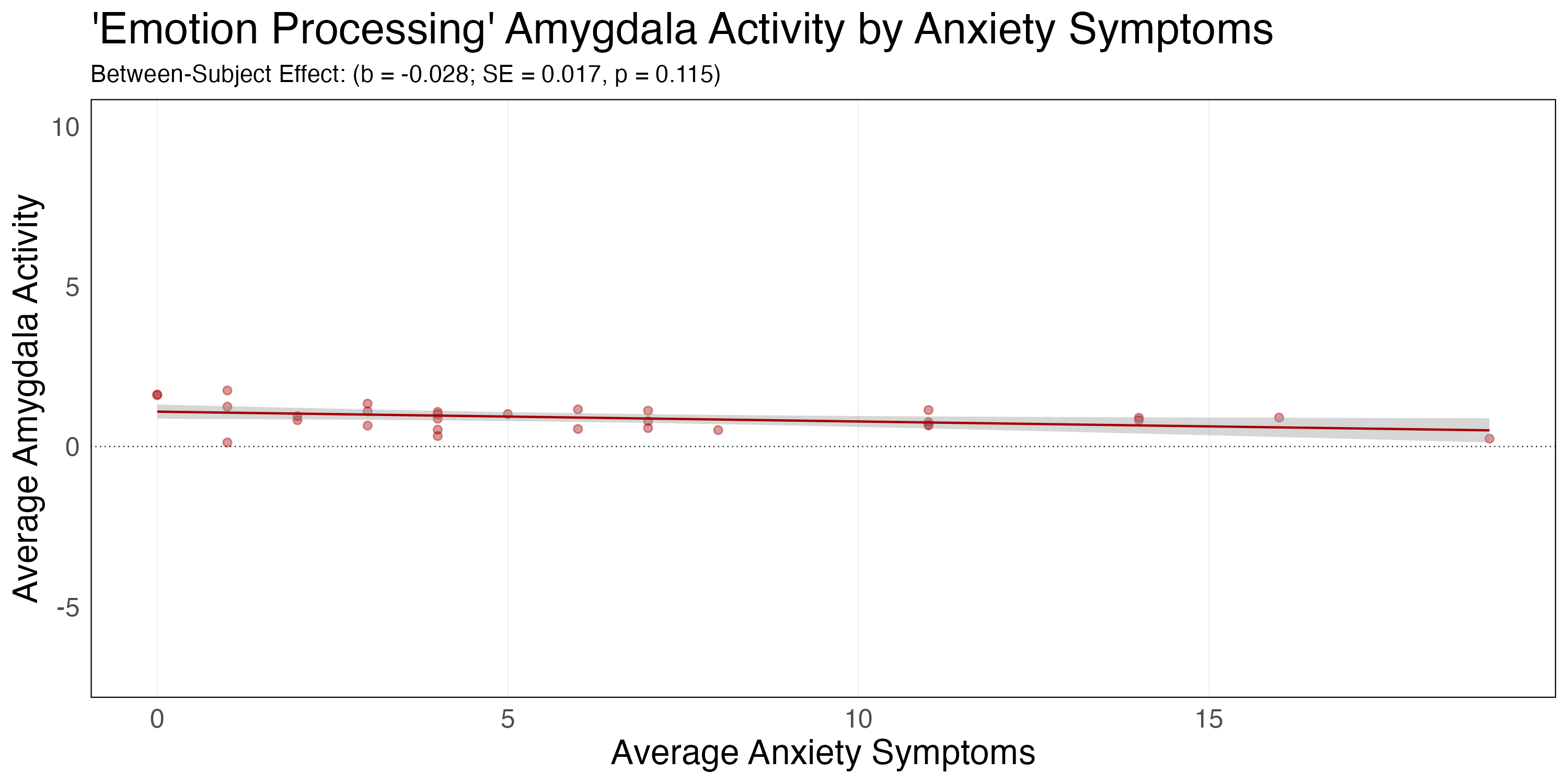
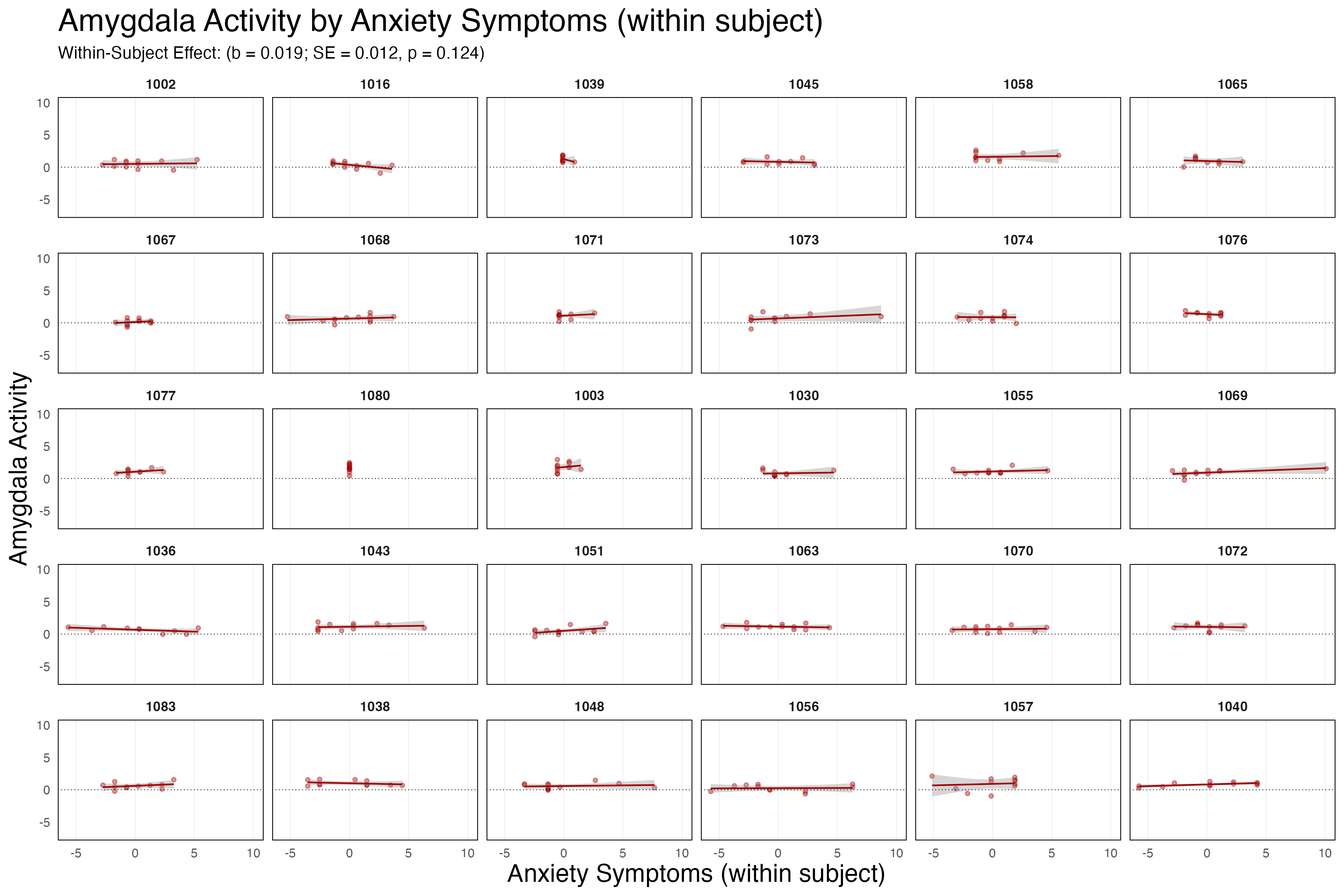
Amygdala. There was no significant association of between-subject anxiety symptoms with activity during emotion processing in the amygdala (b = -0.028, SE = 0.017, p = 0.12). Additionally, there were no significant association with anxiety symptoms within-subject (b = 0.019, SE = 0.012, p = 0.12).
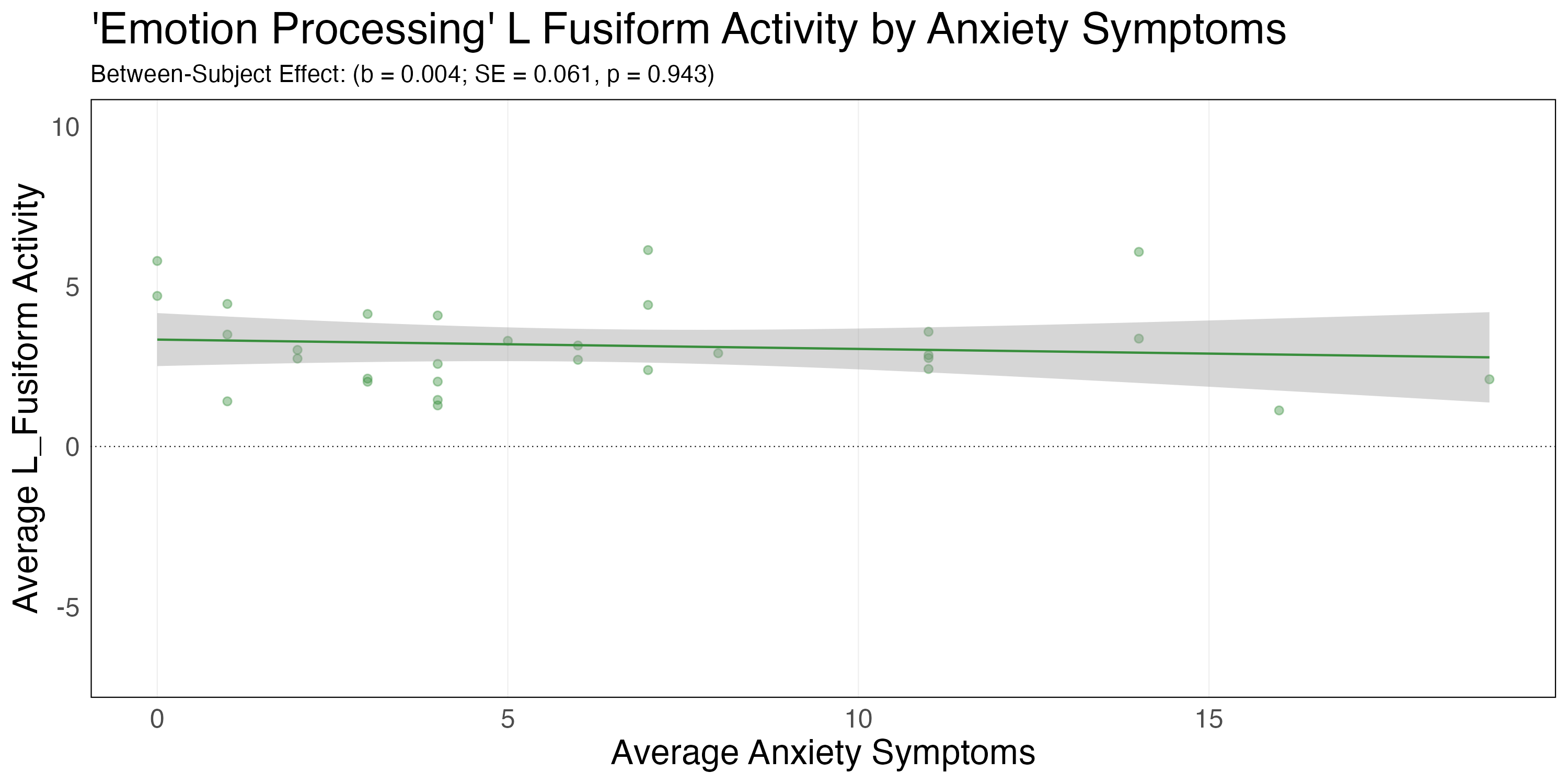
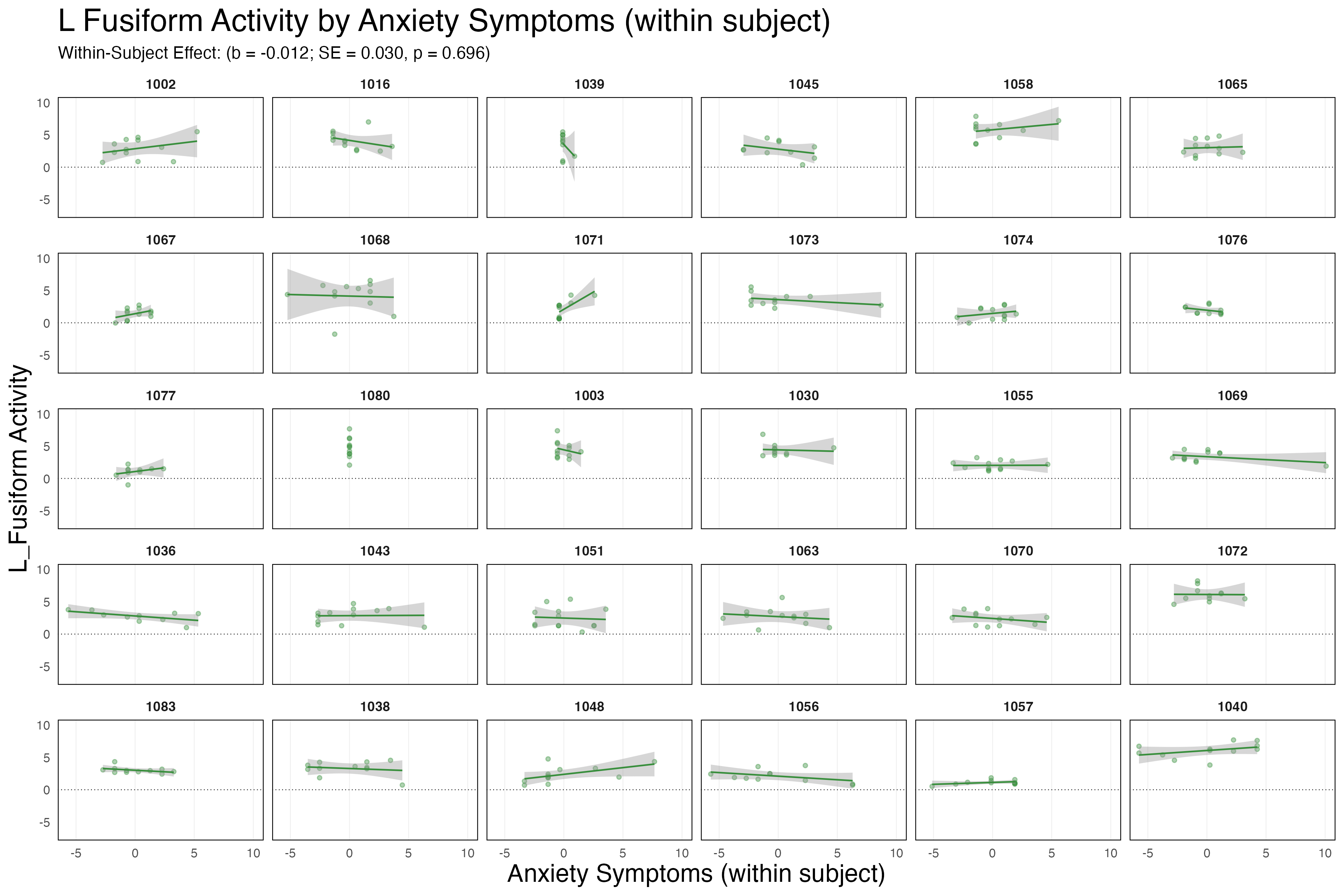
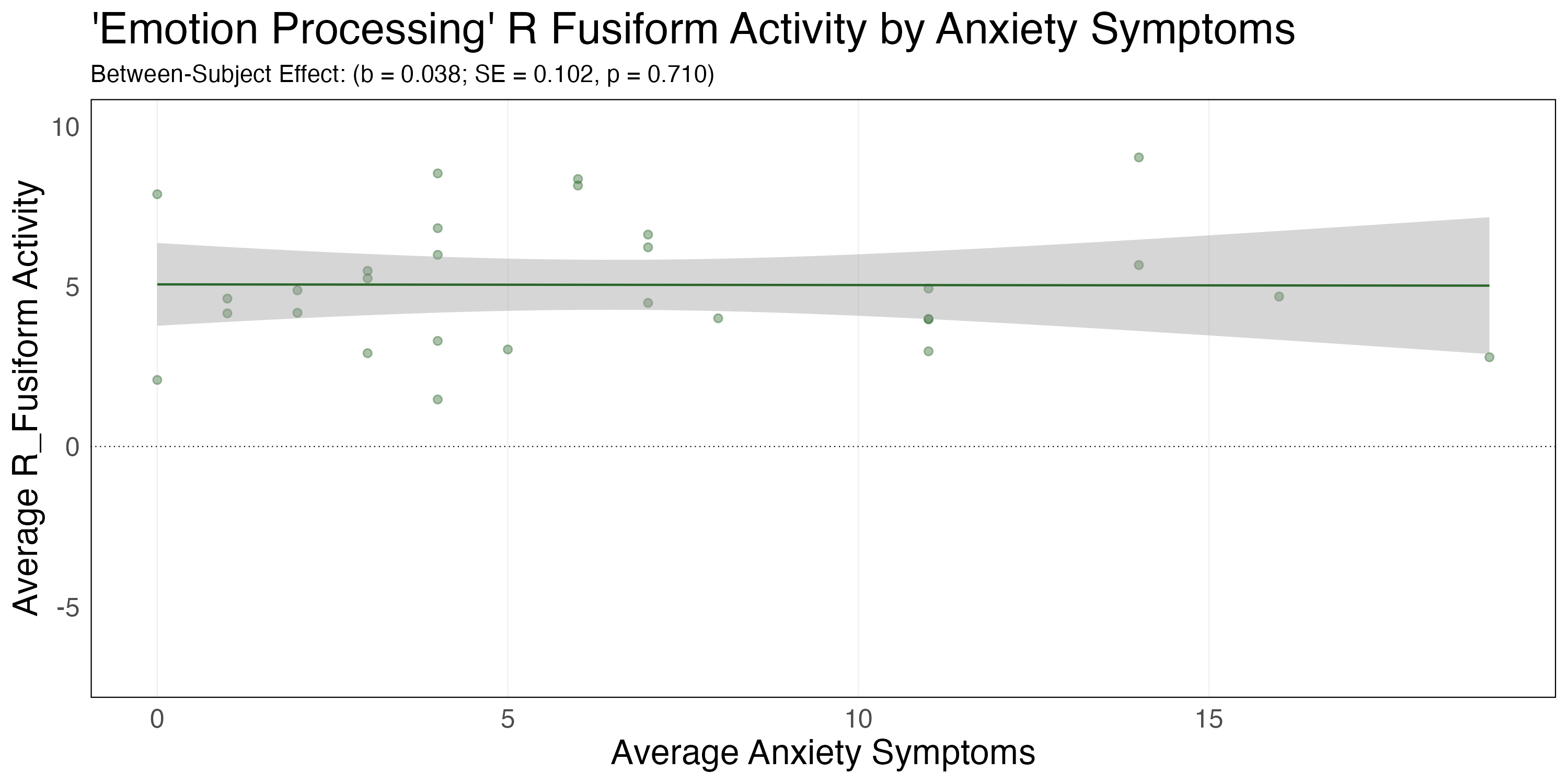
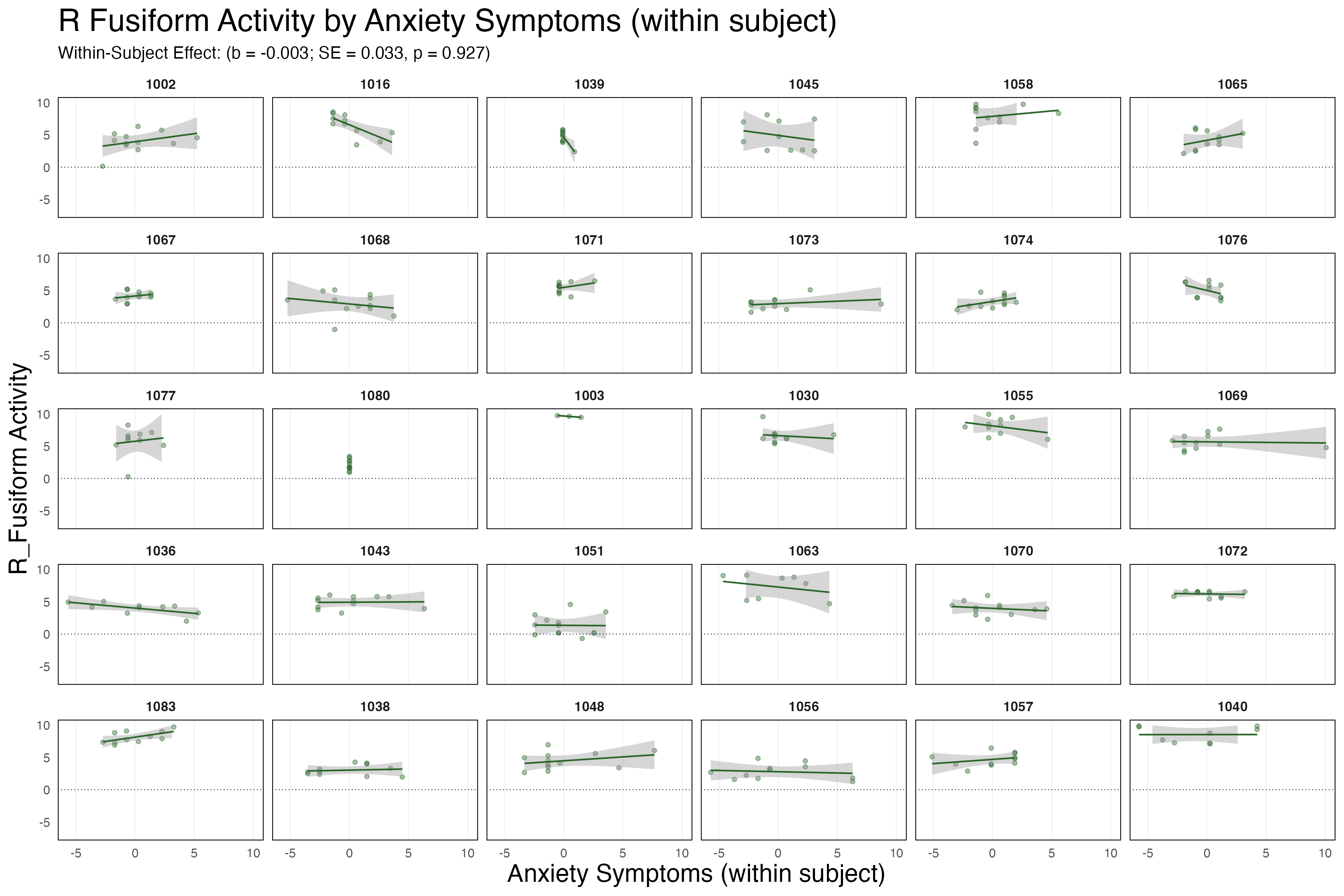
Left and Right Fusiform. There was no significant association of between-subject anxiety symptoms with activity during emotion processing in the left or right fusiform (left fusiform: b = 0.004, SE = 0.061, p = 0.94, right fusiform: b = 0.038 , SE = 0.102 , p = 0.71). Additionally, there were no significant within-subject anxiety symptoms associations with activity during emotion processing (left fusiform: b = -0.012, SE = 0.030, p = 0.70; right fusiform: b = -0.003, SE = 0.033, p = 0.93).
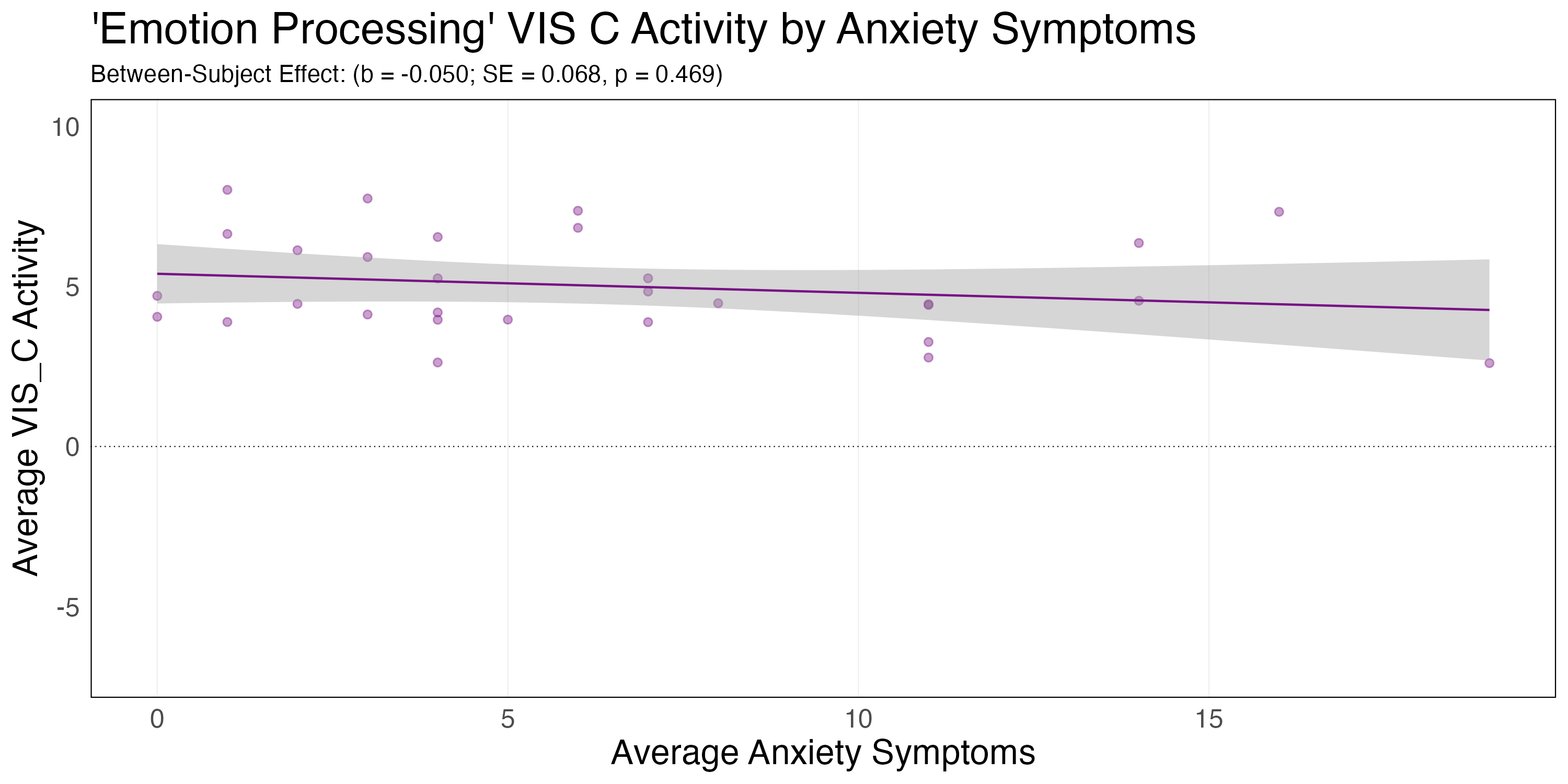
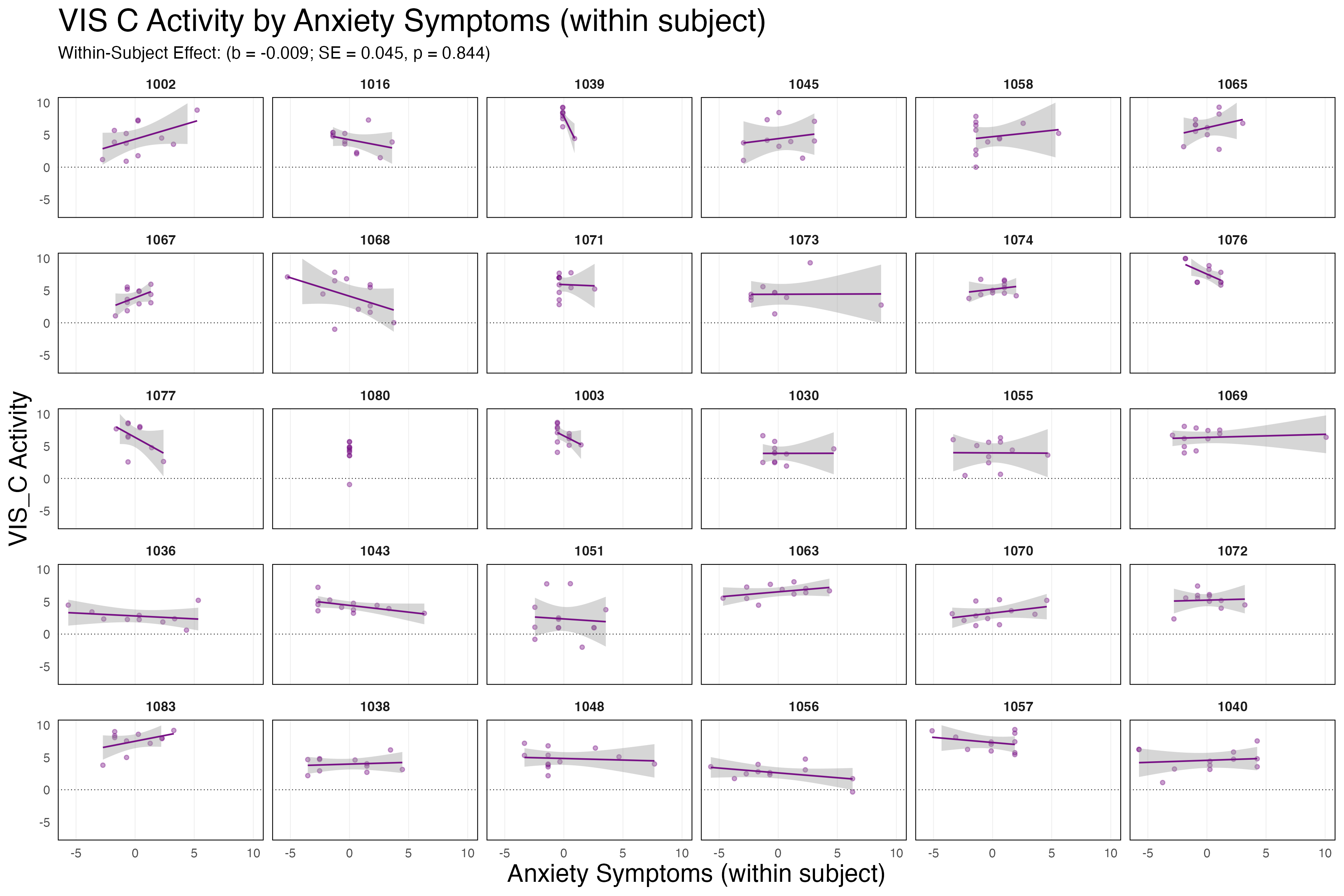
Visual-Central Network (VIS-C). There was no significant association of between-subject anxiety symptoms with activity during emotion processing in the visual-central network (VIS-C) (b = -0.050, SE = 0.068, p = 0.47). Additionally, there was no significant association with anxiety symptoms within-subject (VIS-C: b = -0.009, SE = 0.045, p = 0.84).
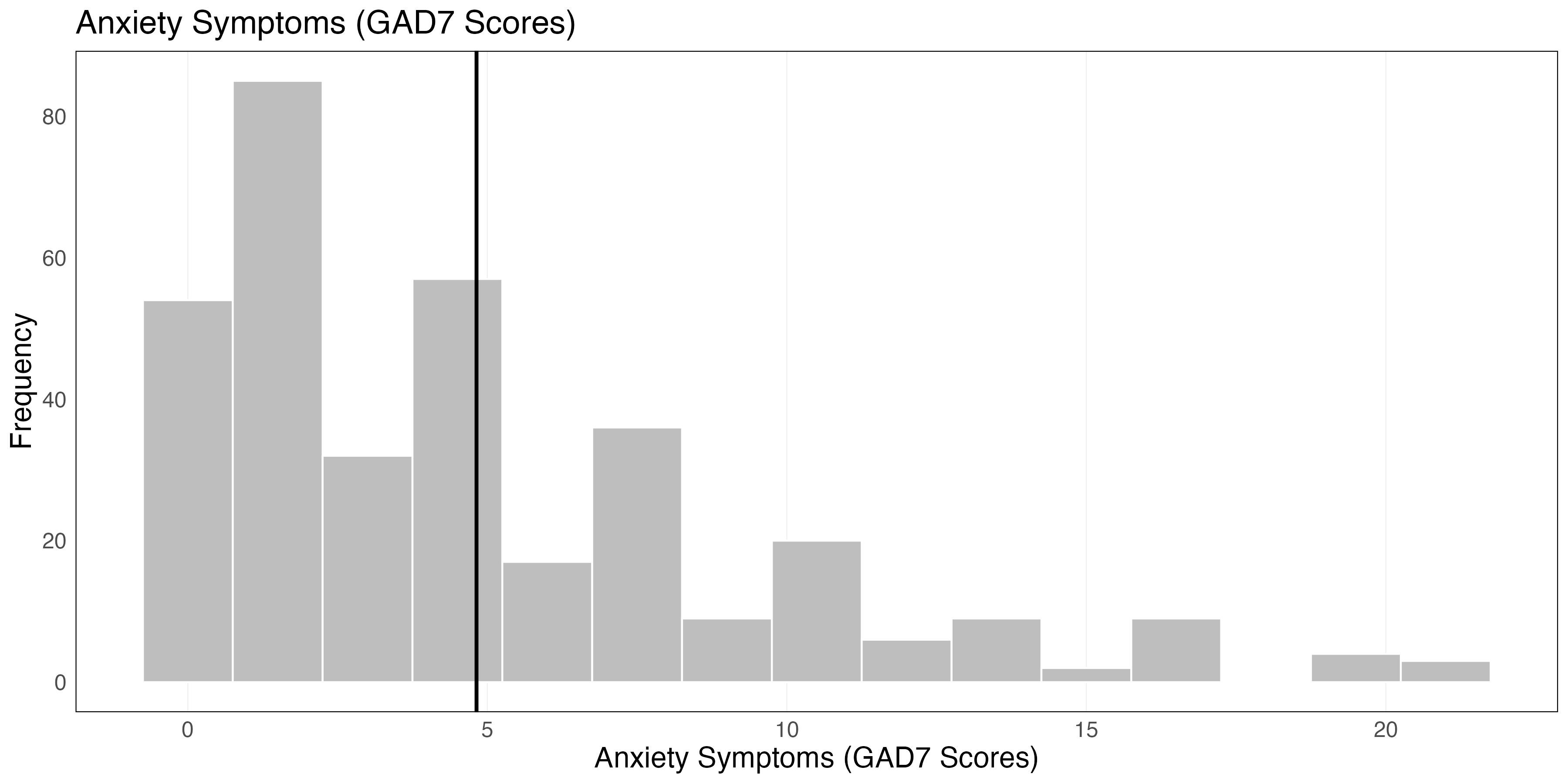
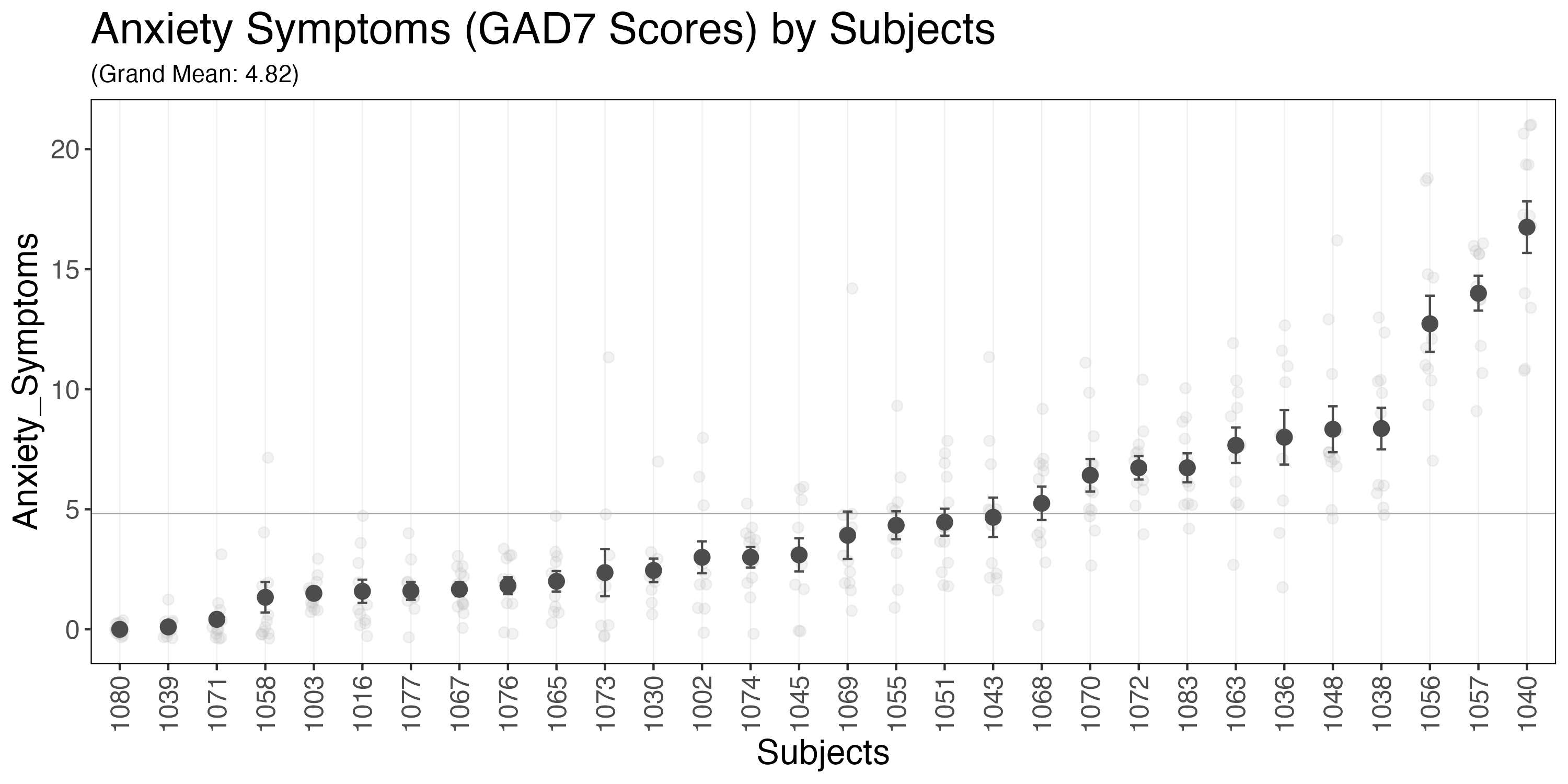
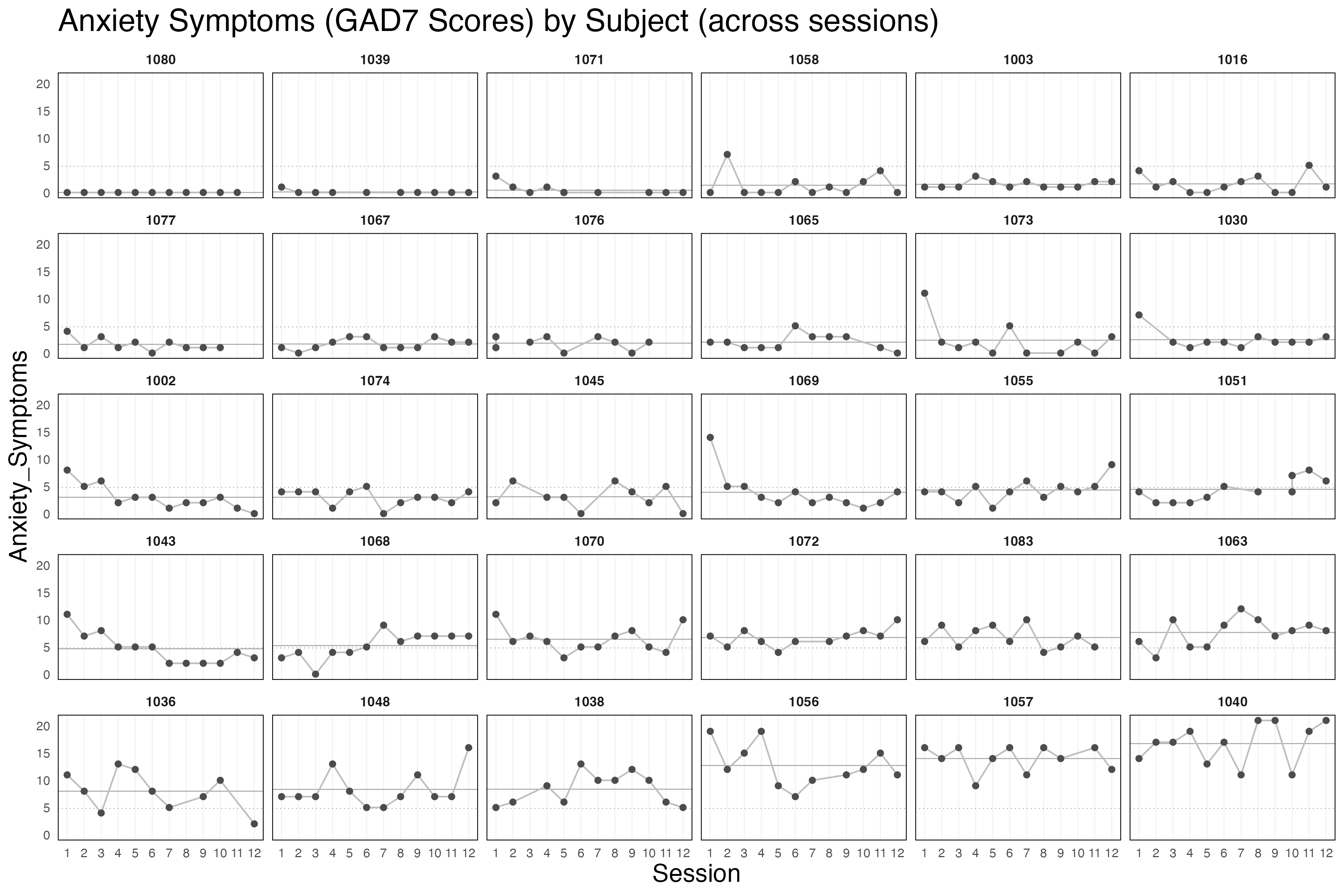
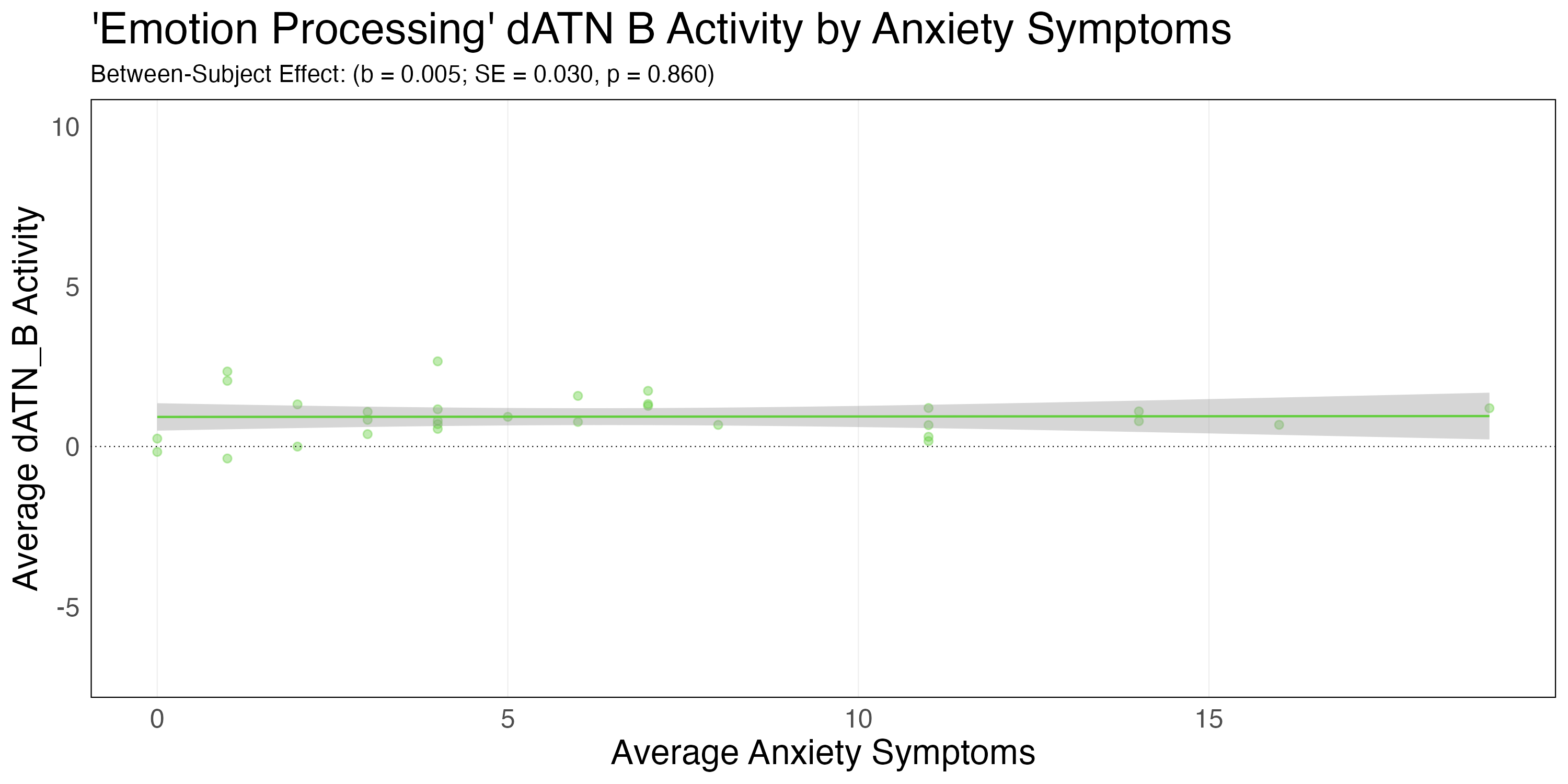
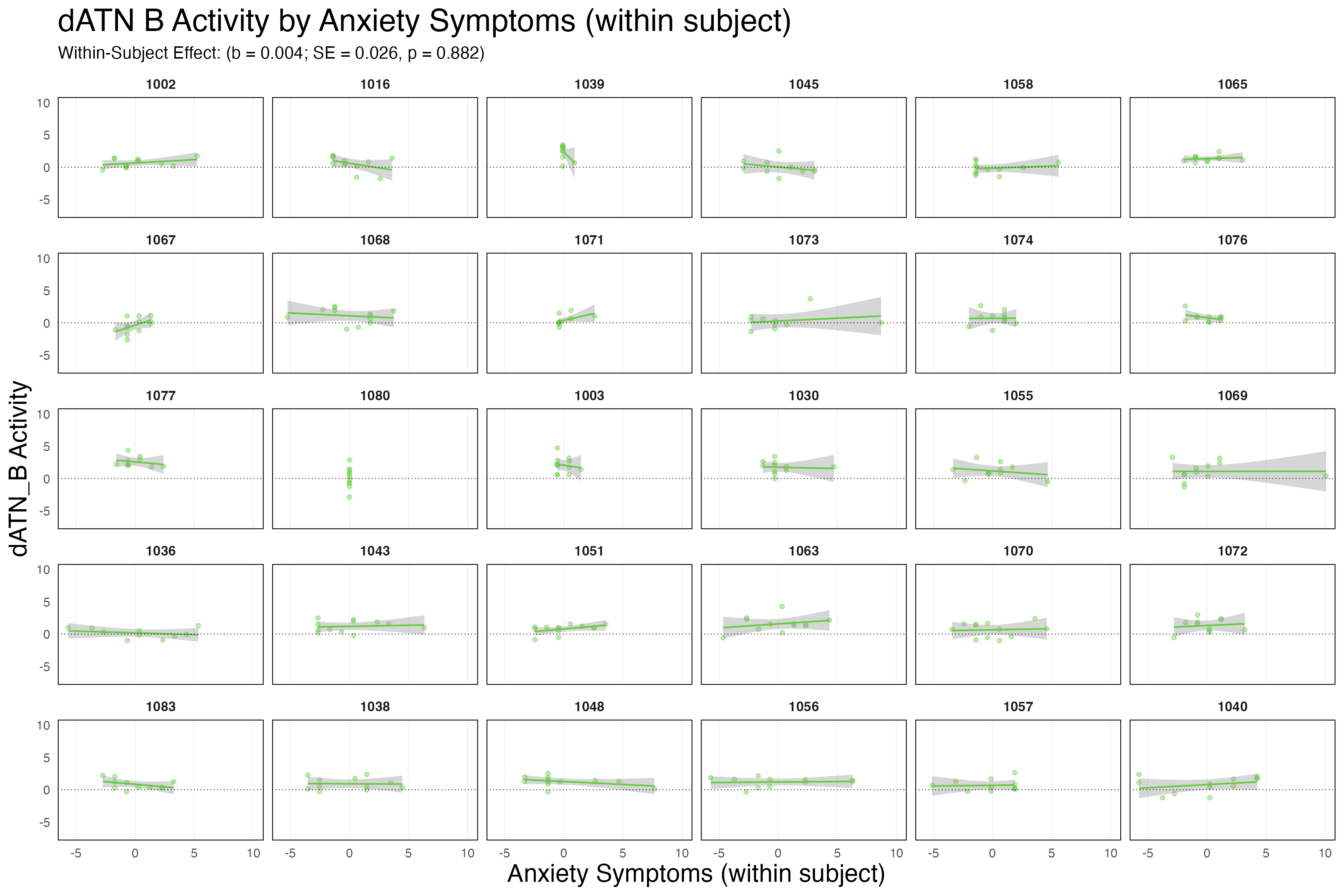
Dorsal Attention Network B (dATN-B). There was no significant association of between-subject anxiety symptoms with activity during emotion processing in dorsal attention network B (dATN-B) (b = 0.005, SE = 0.030, p = 0.86). Additionally, there was no significant association with anxiety symptoms within-subject (b = -0.024, SE = 0.035, p = 0.488).
Page in Review:
In sum, I did not observe any significant associations of stressful life events, depression symptoms or anxiety symptoms with activity during emotion processing within the the amygdala, the fusiform, visual-central network (VIS-C) or dorsal attention network B (dATN-B). This was true both in terms of between-subject associations, as well as within-subject associations.
Though I did not observe meaningful associations between activity in this task and factors such as stressful life events and symptoms of psychopathology (either between or within individuals), I wanted to confirm that the activity in the individualized networks is sensitive to task-level effects. In the following section I will examine the associations between activity in these networks and task performance (task accuracy and response time).