The Emotion Task
Note that these sections are big picture overviews to provide a general understanding. For detailed methodological details please refer to the methods section.
The canonical emotion task used in the following two projects is a fMRI task designed to elicit emotion processing activity in the brain (with an emphasis on inducing a robust amygdala response) (Hariri et al., 2000, 2002). The task consists of two conditions: the faces condition and the shapes condition.
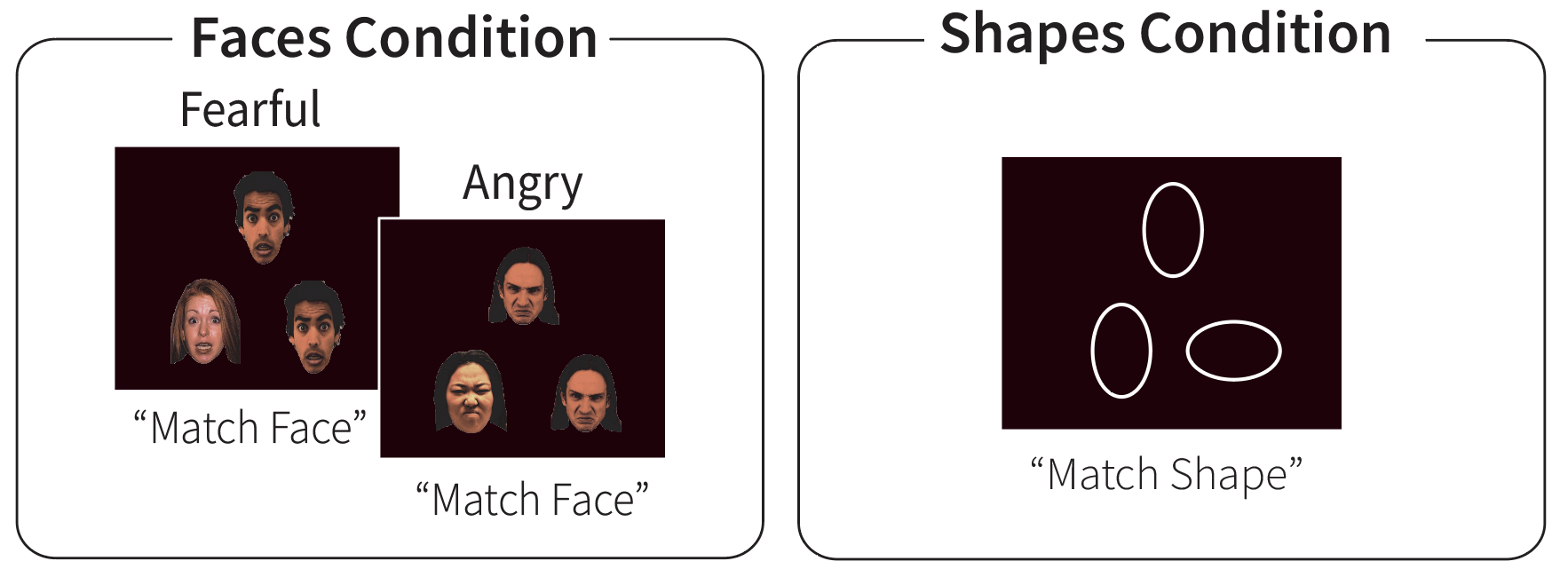
During both conditions subjects are directed match a target image, presented at the top of the screen, to one of two images presented at the bottom of the screen using a button press. In the faces condition, stimuli consist of angry and fearful faces (ie. threat faces). Only threatening face stimuli are used during the faces condition, as the task was designed to elicit a strong amygdalar response (Hariri et al., 2000, 2002). The stimuli used during the shapes condition consist of simple white outlines of circles and ovals.
Emotion Processing Activity. Given the task design, emotion processing activity is the difference in brain activation during the faces condition relative to the shapes condition (Faces > Shapes). By contrasting these two conditions, activity that is specific to emotion processing can be isolated from activity associated with general task demands that are shared across the two conditions, such as directing external attention to a simple task, basic matching decisions, a button press, etc.. Given the broad contrast used in this task, the observed contrast activity (Faces > shapes) captures a wide range of higher-order processing involved in perceiving emotional faces, including face processing, identity processing, as well as detection of emotional salience. Other tasks that isolate emotion processing activity may use different contrasts, such as threat faces versus neutral faces which result in much tighter control and more specific emotion processing activity (eg. Flournoy et al., 2023).
NOTE: Given that emotion processing activity is the contrast between the faces condition and the shapes condition, it is possible to have positive emotion processing activity that is the result of less negative activity during the faces condition as compared to the shapes condition. We are only interested in activity that is the result of more positive activity during the faces condition as compared to the shapes condition, and not the result of less negative activity. So any results that pertain to less negative activity will not be highlighted or discussed in the context of emotion processing activity in this work.
Participants:
Participants were drawn from the Studying Adolescents in Real-time (STAR) study dataset. The STAR study is a massive ongoing data collection effort organized by Dr. Katie McLaughlin, designed to examine the mechanisms linking early life stress to psychopathology. All subjects were recruited from the greater Boston area and were selected to have variability in race, ethnicity, and socioeconomic status. The final analytic sample used here consists of 30 subjects ages 13-17, assessed monthly over the course of a year.
Each of the 30 subjects completed the emotion processing task during each monthly study session, totaling 12 task completions per subject. This rich longitudinal data set allows us to characterize activation within the boundaries of interest (amygdala, meta-analytic ROIs, group average networks, and individualized networks) during emotion processing, but also explore the variability in emotion processing activation between subjects (aka. individual differences), and variability in emotion processing within subject over time (aka within-person fluctuations). An exploration of variability in emotion processing is the primary focus of project 3.