Task Performance
Section 1. Effects of Task Performance
In this section we will examine the extent to which ‘emotion processing’ activity in the target boundaries is associated with the task performance measures (task accuracy and response time)
The emotion processing task involved subjects making a button press to identify which stimuli matched a target image displayed at the top of the screen. This button press was designed to ensure subjects were attending to the task and also to provide a contrast setting where passive ‘emotion processing’ activity could be dissociated. This button press provides the opportunity to evaluate two different task performance measures: task accuracy and response time. Task accuracy is measured as the percentage of trials in which the subject correctly matched the target face or shape. Response time is measured as the time it took the subject to make a response during the task.
Task Performance Variables Visualized
Task Accuracy
The emotion processing task is an extremely easy task, with subjects performance at an average of 83%. 55% of subjects performed at 90% accuracy or higher on average across both conditions. There was not a significant difference in task accuracy across the two conditions (faces and shapes) (b = 0.251, SE = 1.404, p = 0.858).
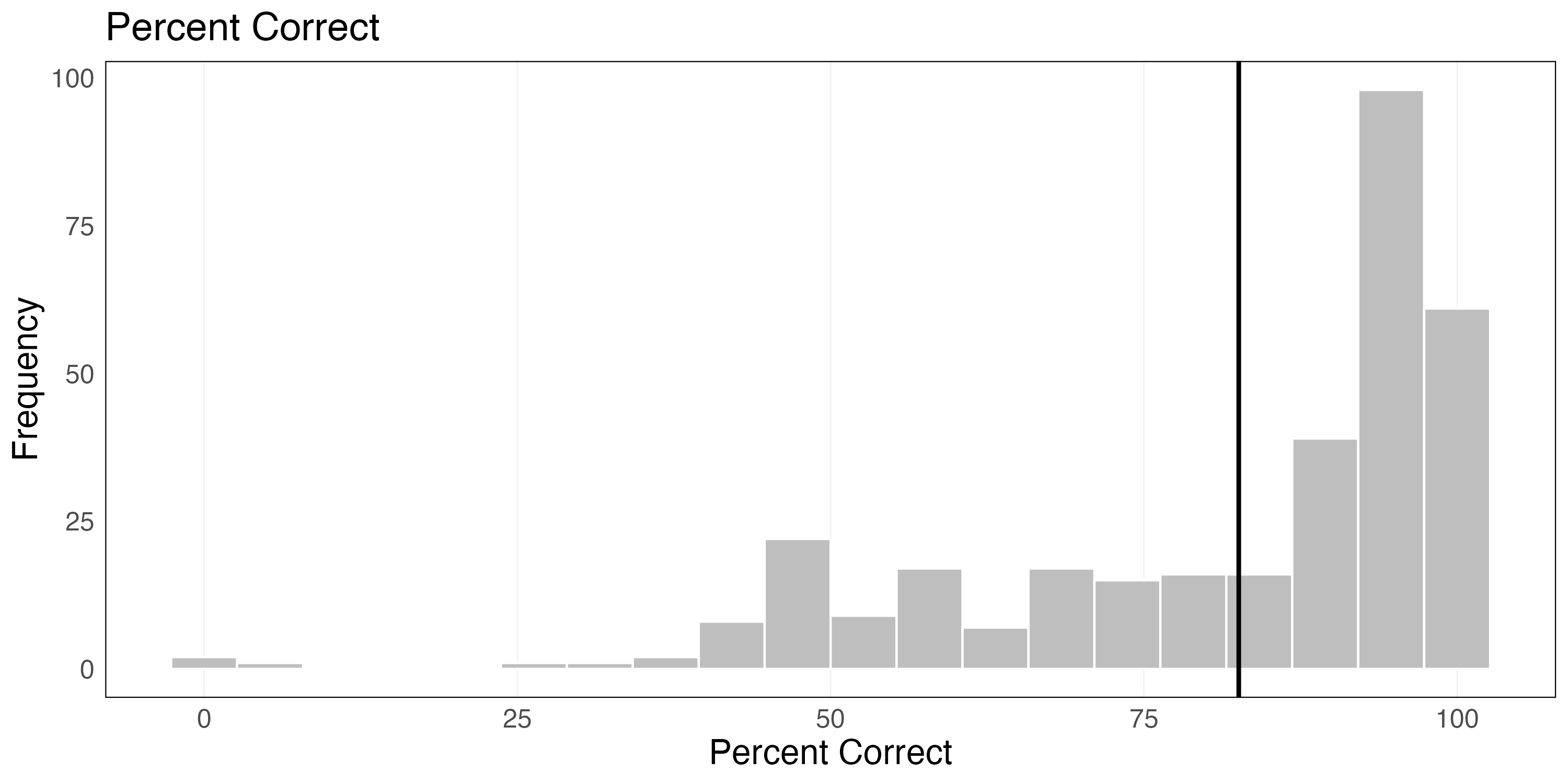
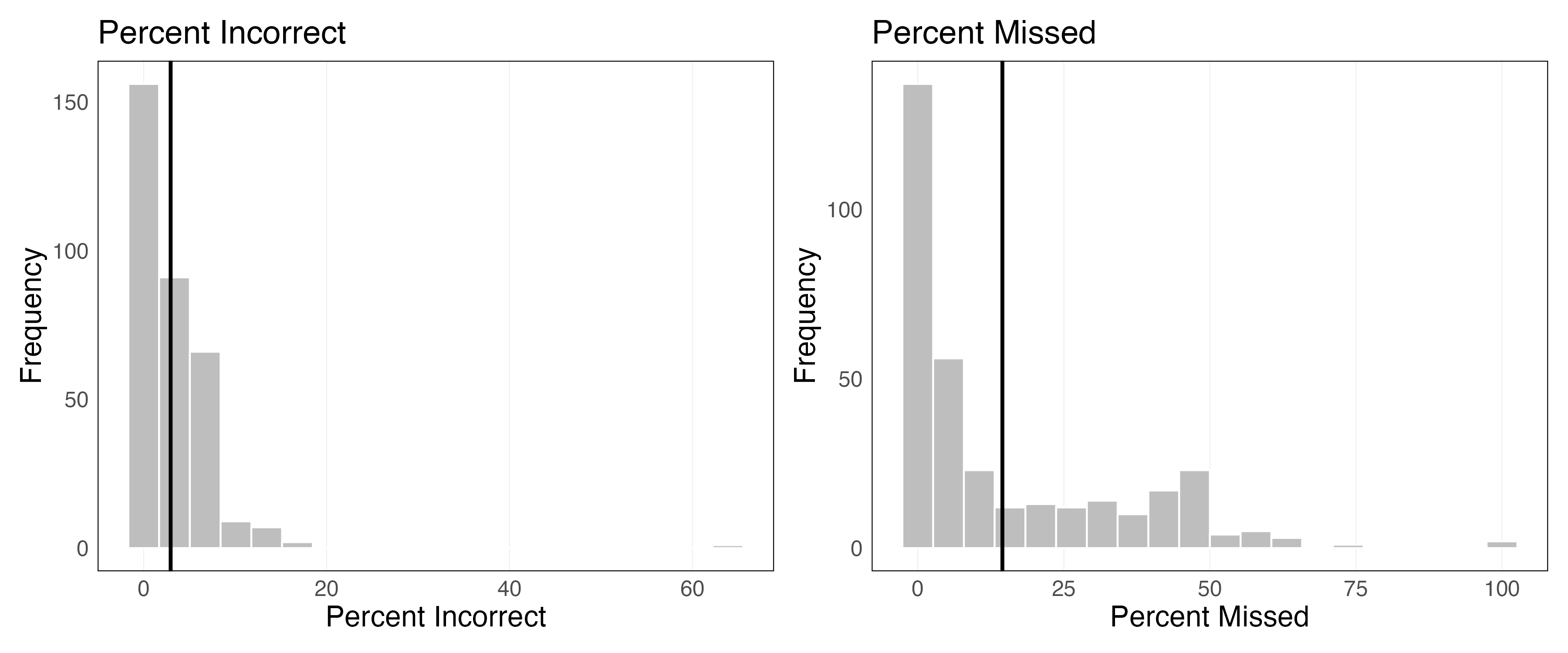
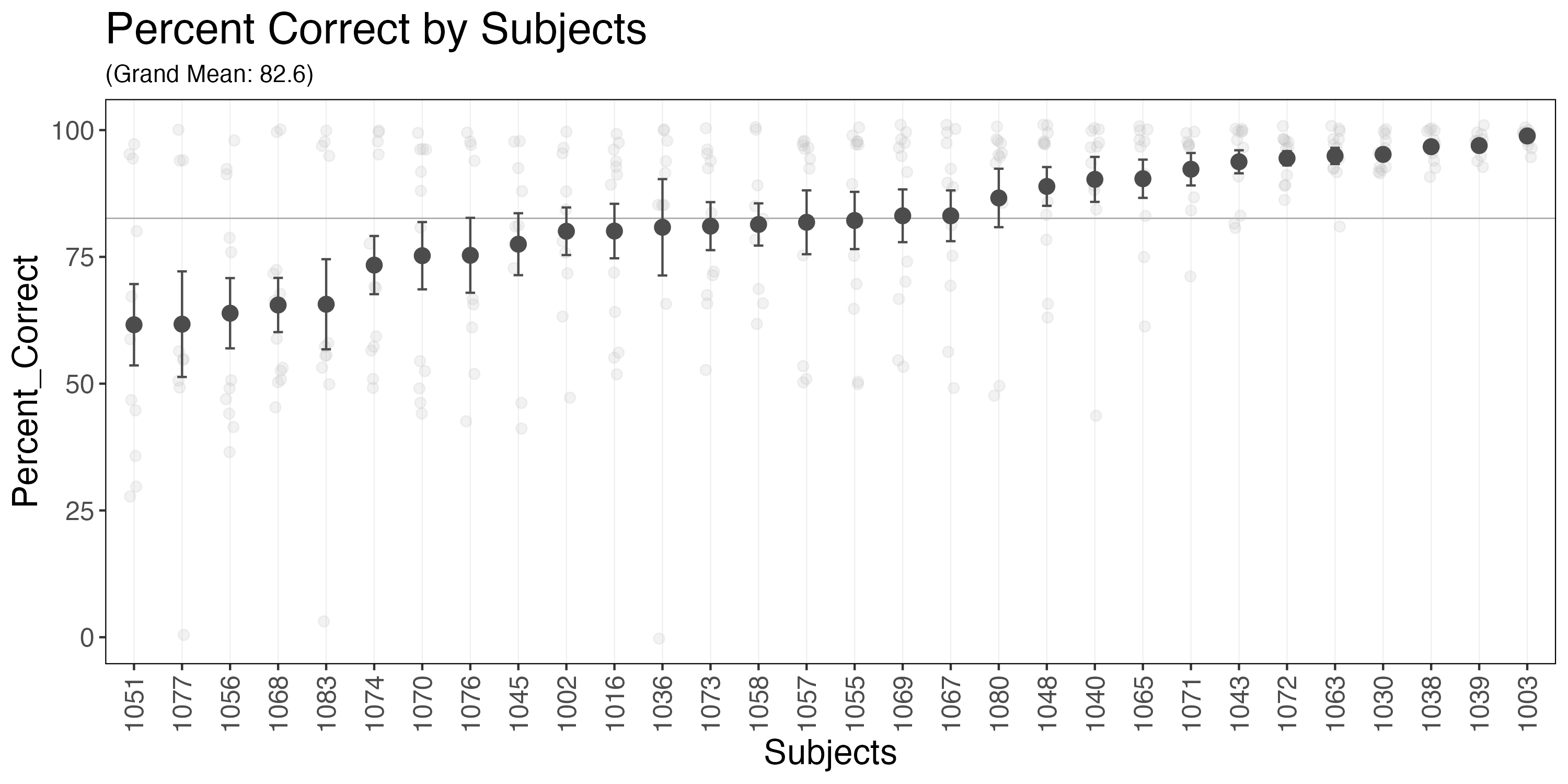
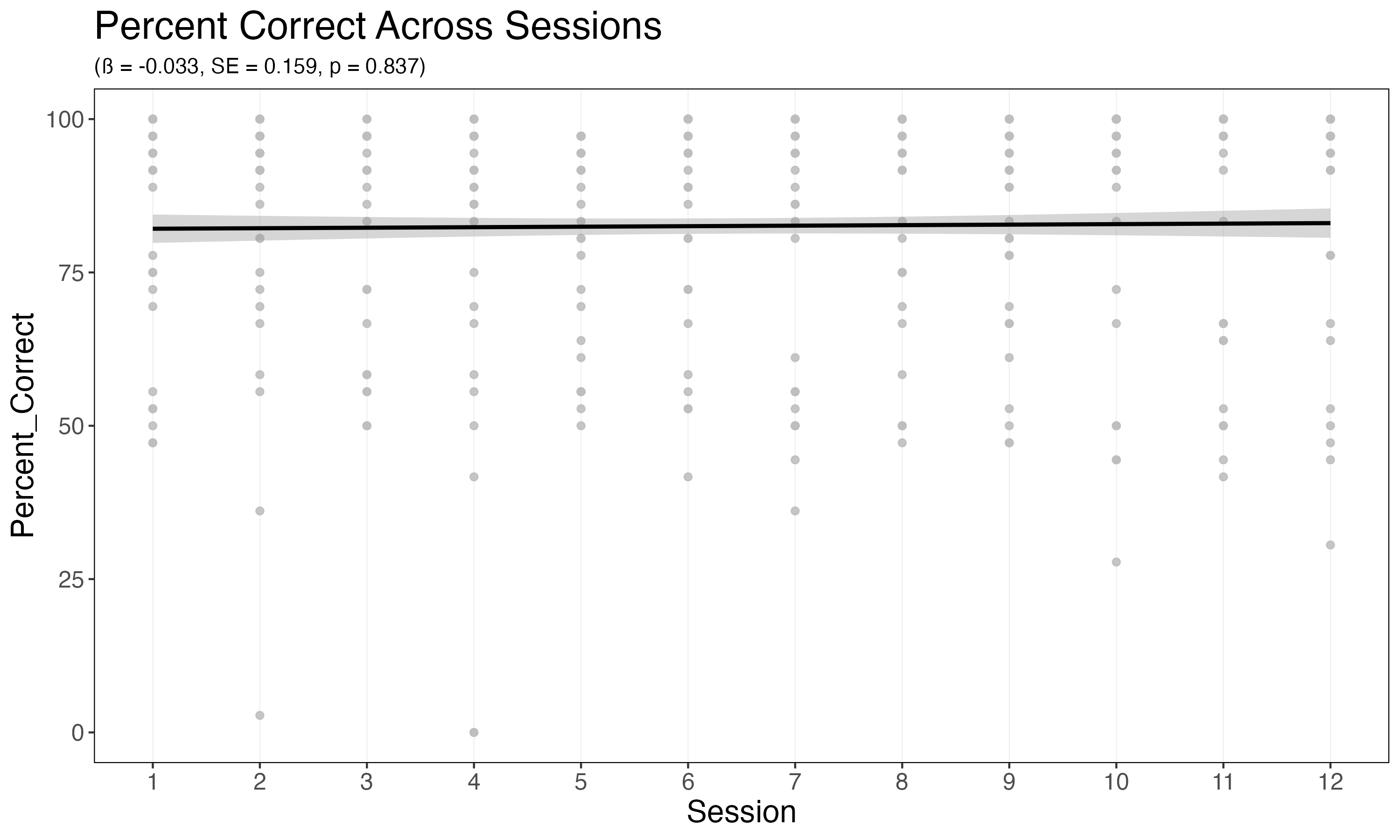
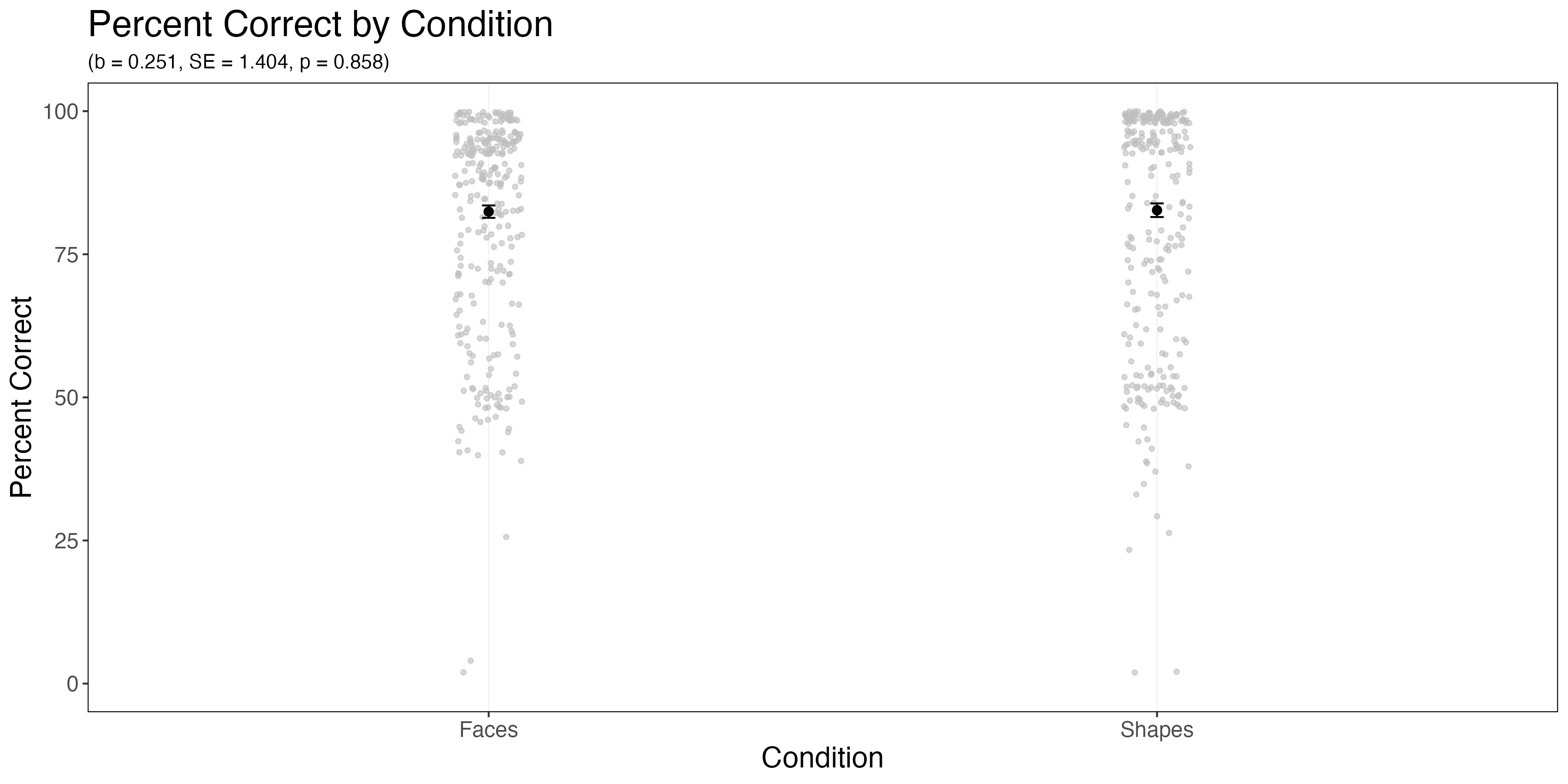
The observed ceiling effects makes it difficult to observe any meaningful associations between task accuracy and ‘emotion processing’ activity as there is limited variability in accuracy. However, we will still examine the extent to which task accuracy is associated with activity in the target boundaries.
Associations Between Activity and Task Accuracy
[INSERT IMAGE HERE]
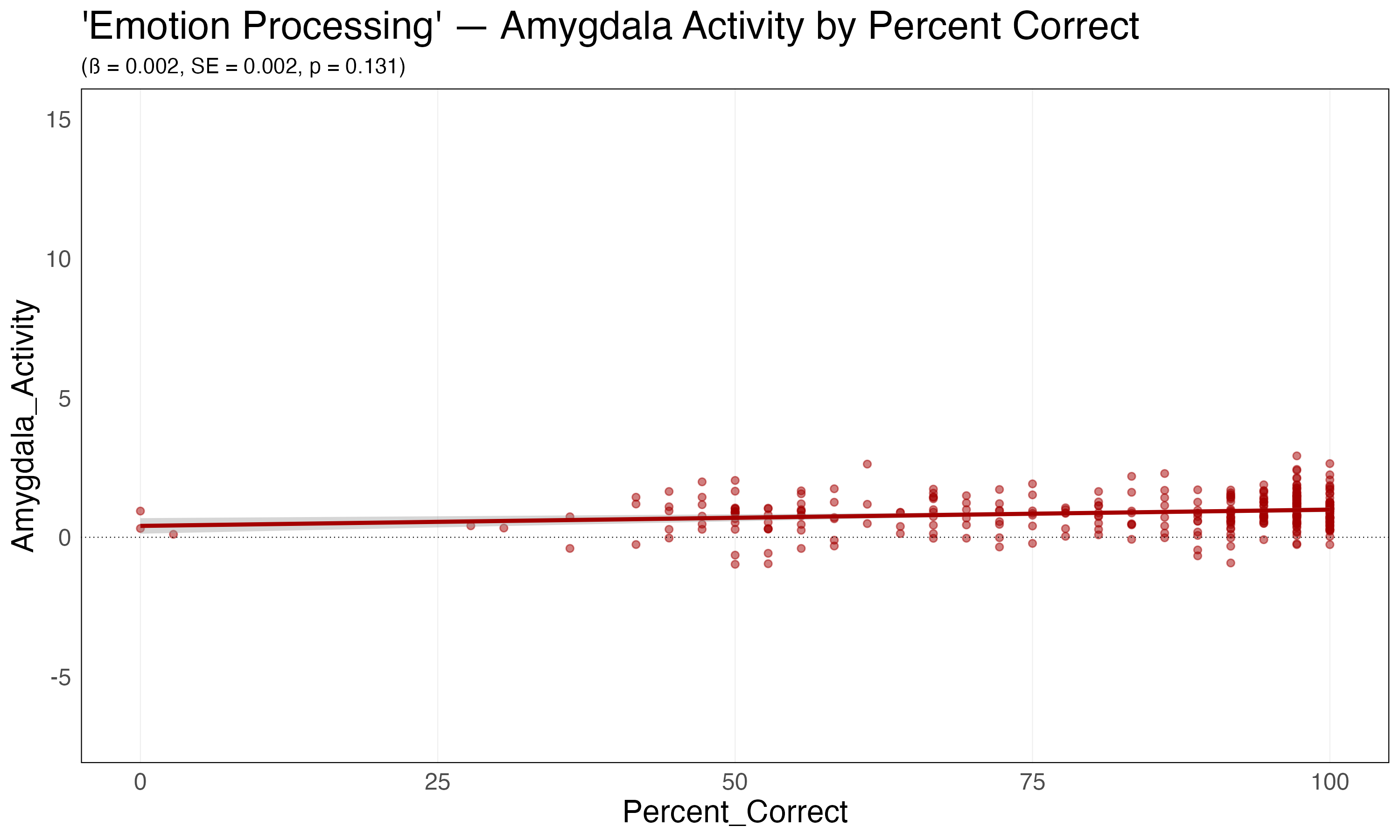
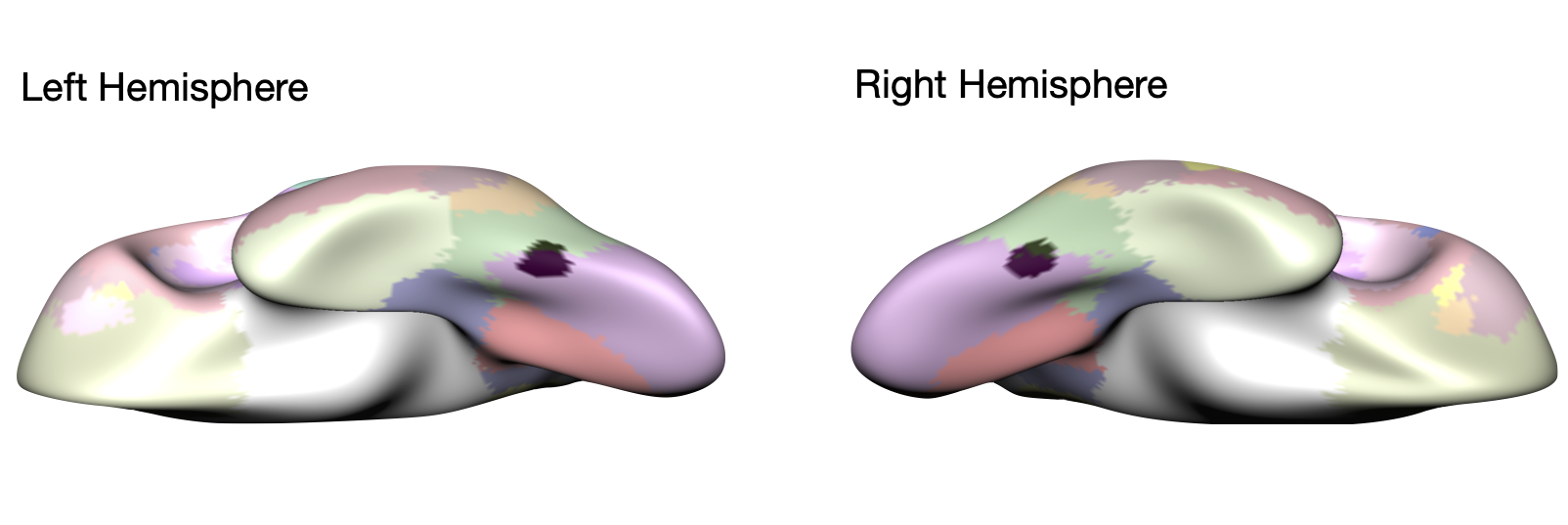



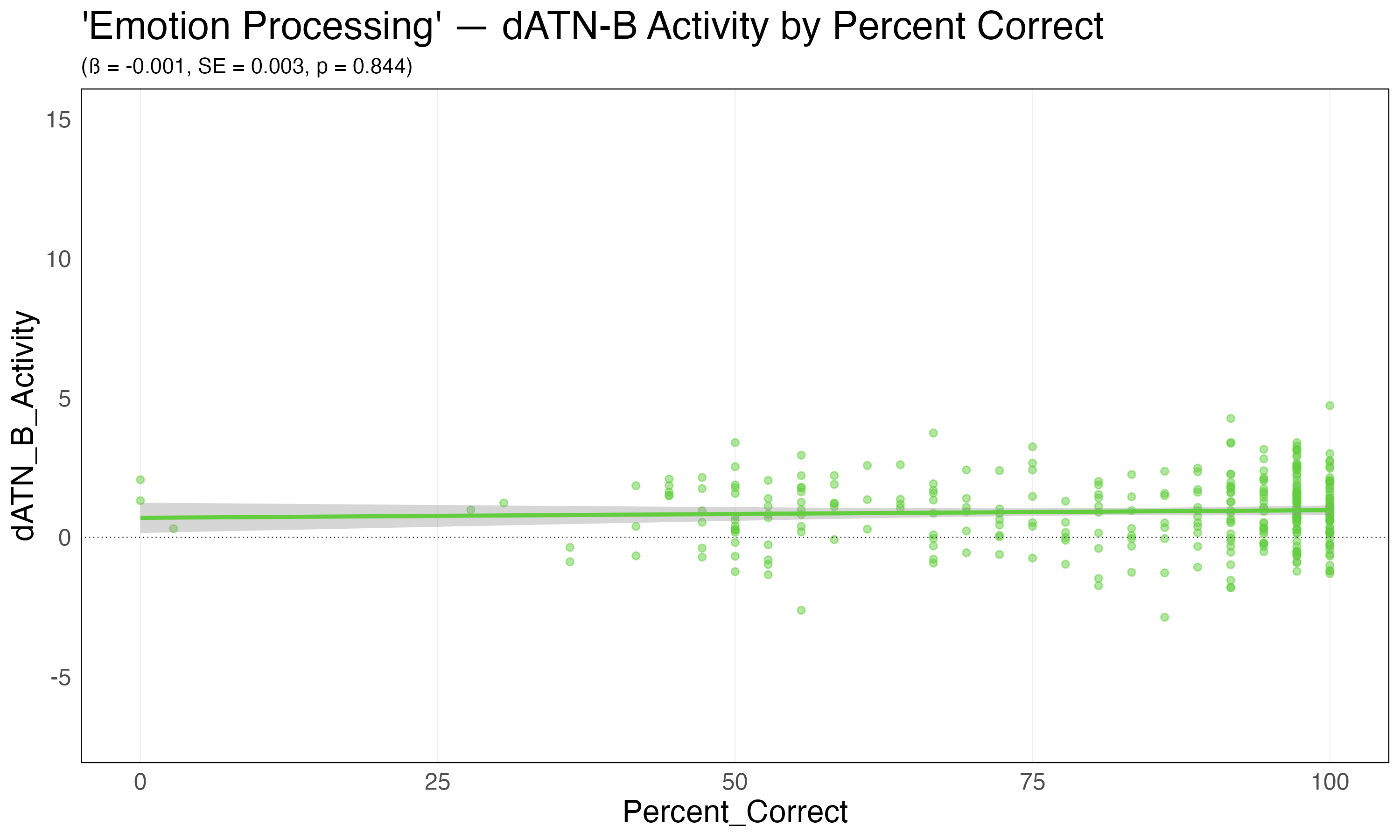
Amygdala. Amygdala activity was not associated with task accuracy (b = 0.002, SE = 0.002, p = 0.13).
Left and Right Fusiform. Both left and right fusiform activity was positively associated with task accuracy, such that higher accuracy was associated with higher activity (right fusiform: b = 0.011, SE = 0.004, p = 0.003, left fusiform: b = 0.011, SE = 0.004, p = 0.009).
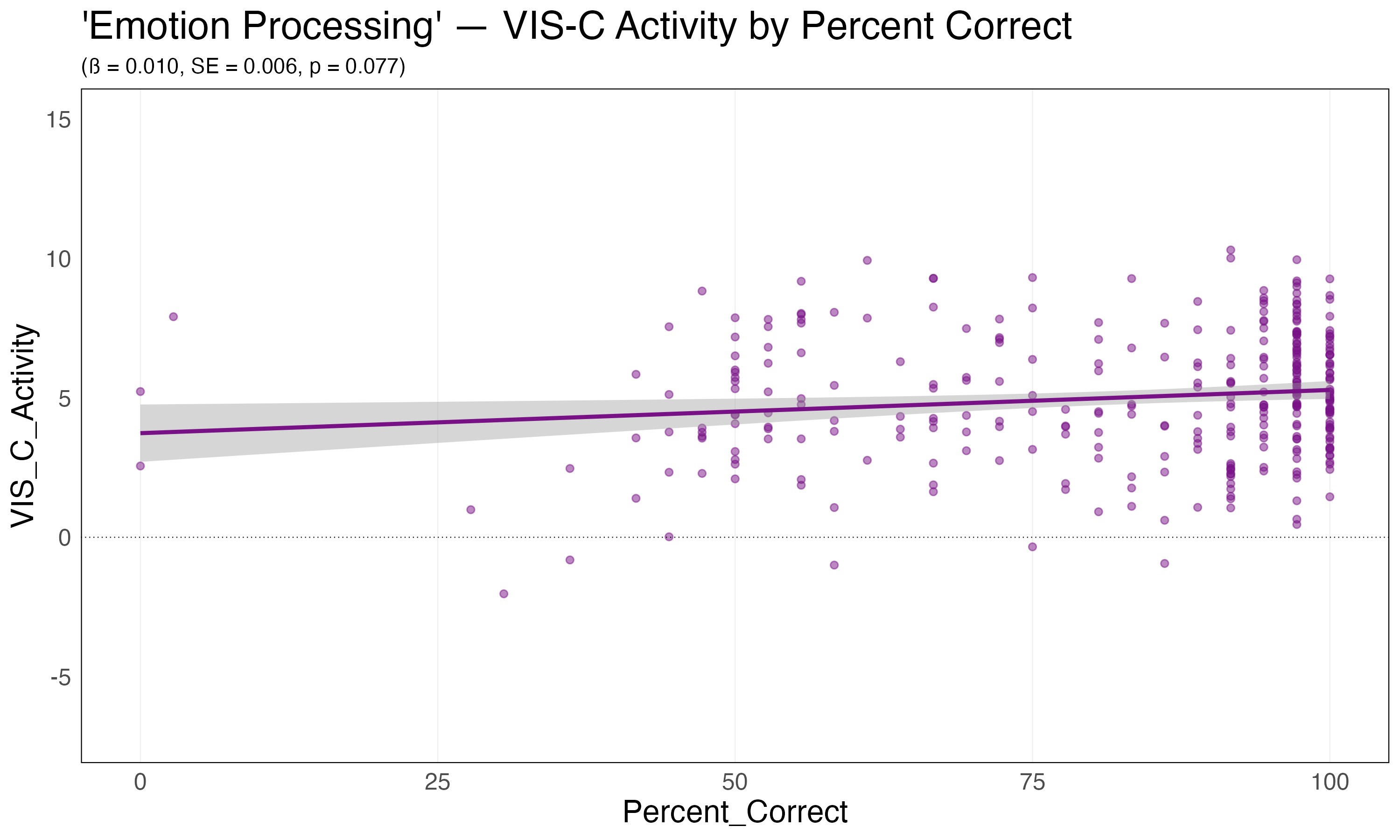
Visual-Central Network (VIS-C). Visual-central network (VIS-C) activity exhibited a slight positive association with task accuracy, but this association was not meaningfully significant (b = 0.010, SE = 0.006, p = 0.077).
Dorsal Attention Network B (dATN-B). dorsal attention network B (dATN-B) activity is not associated with task accuracy, such that higher accuracy was associated with higher activity (b = -0.001, SE = 0.003, p = 0.003).
In sum, only the Meta-Analytic Regions (right and left fusiform) showed a significant association with task accuracy. Though the visual-central network (VIS-C) seemed to show a slight association with accuracy, this effect was not significant and neither was associations in dorsal attention network B (dATN-B). These findings suggest that cortical regions may be more sensitive than networks to small effects and factors with limited variability.
Response Time
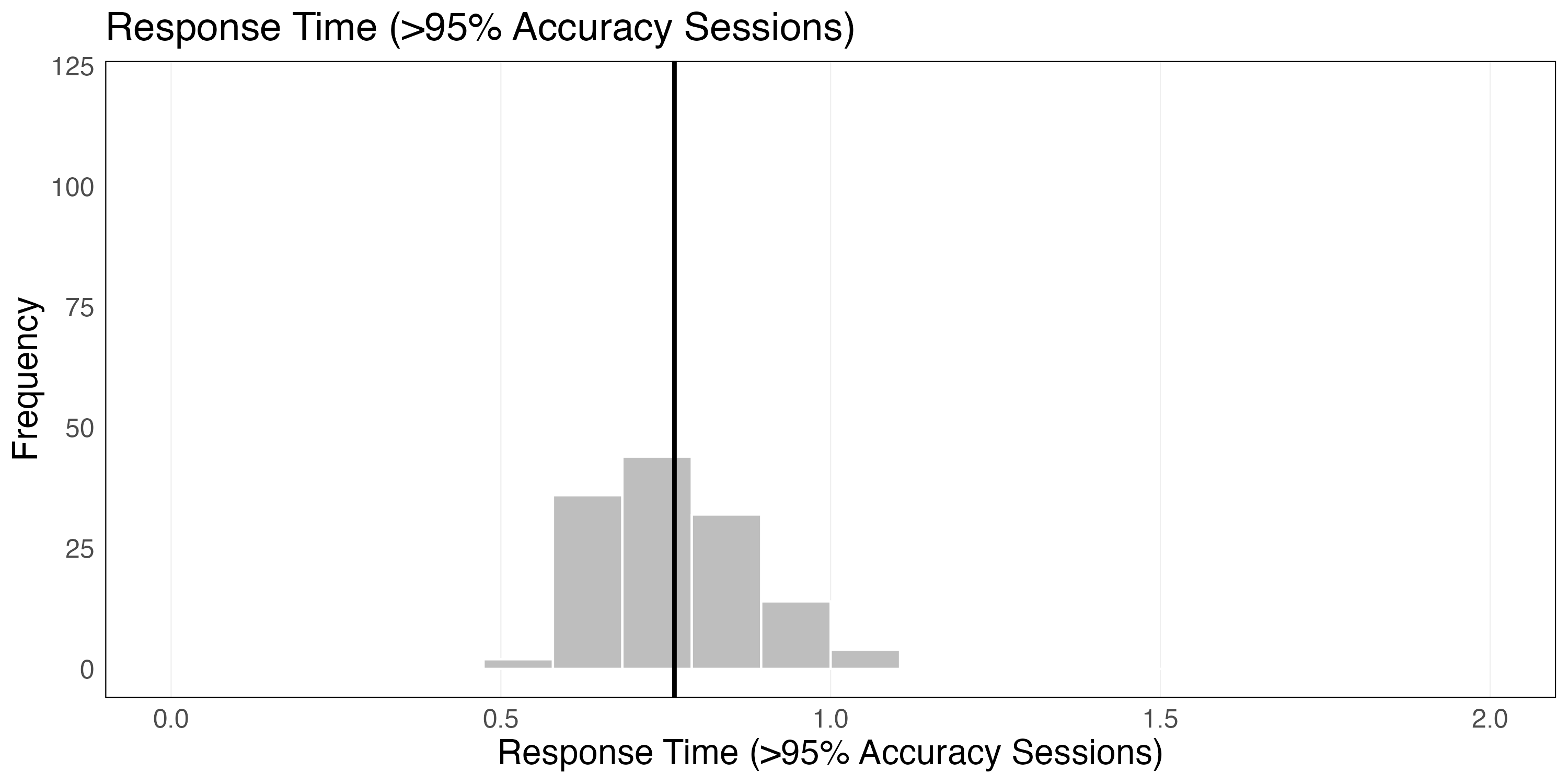
For the purposes of the follow analysis, we will only examine the effect of response time on activity for sessions where the subject’s accuracy was greater than 95%. We did this to dissociate response time effects from overall accuracy.
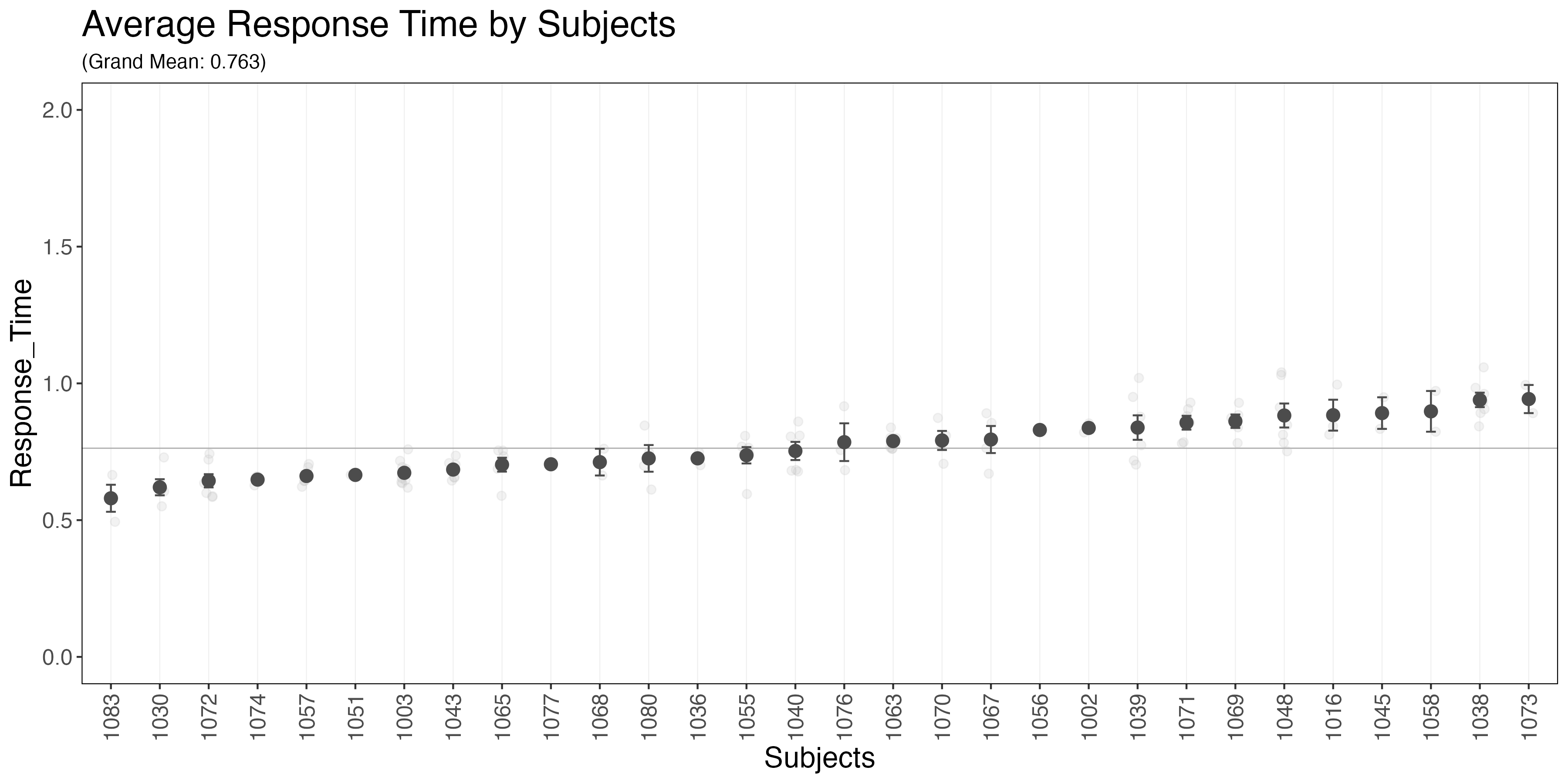
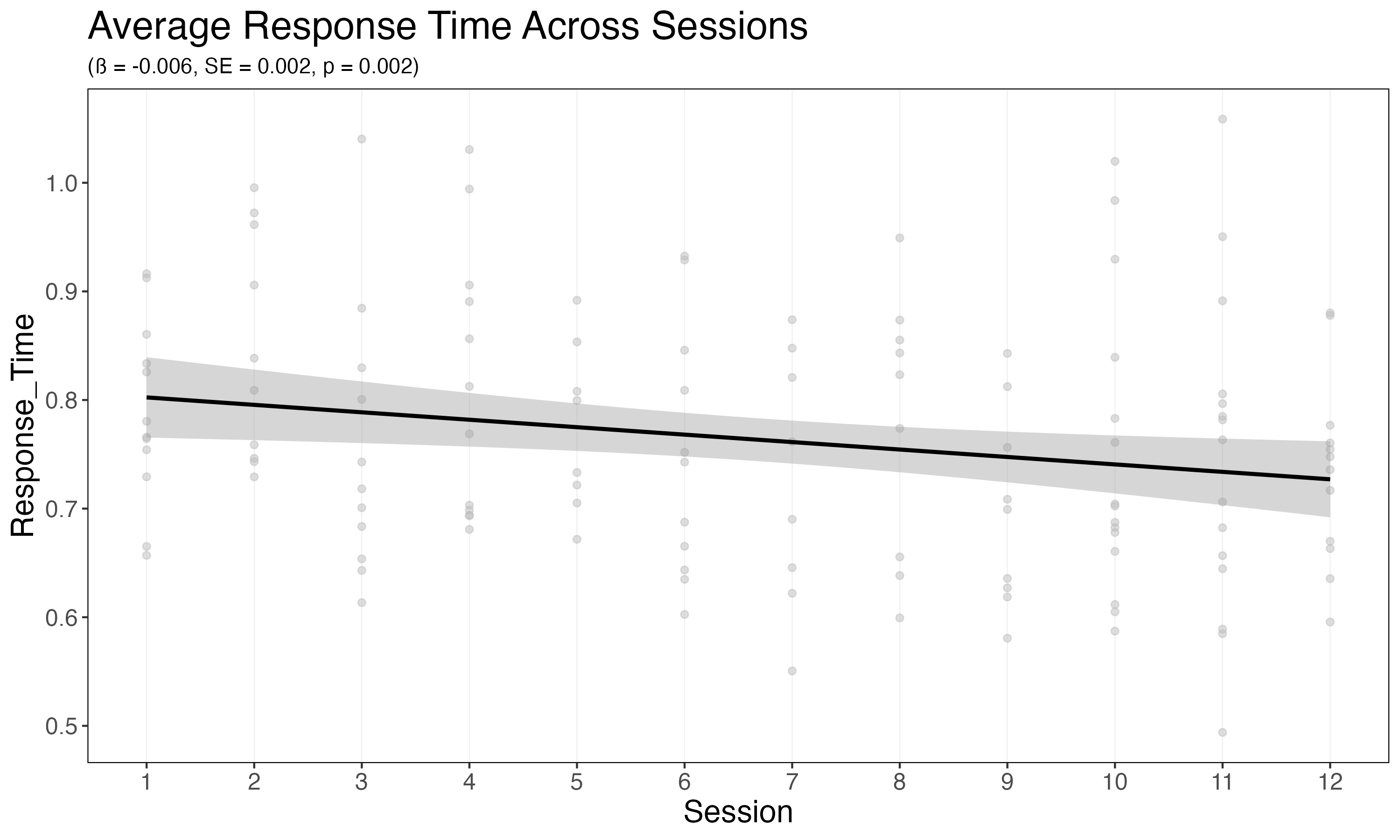
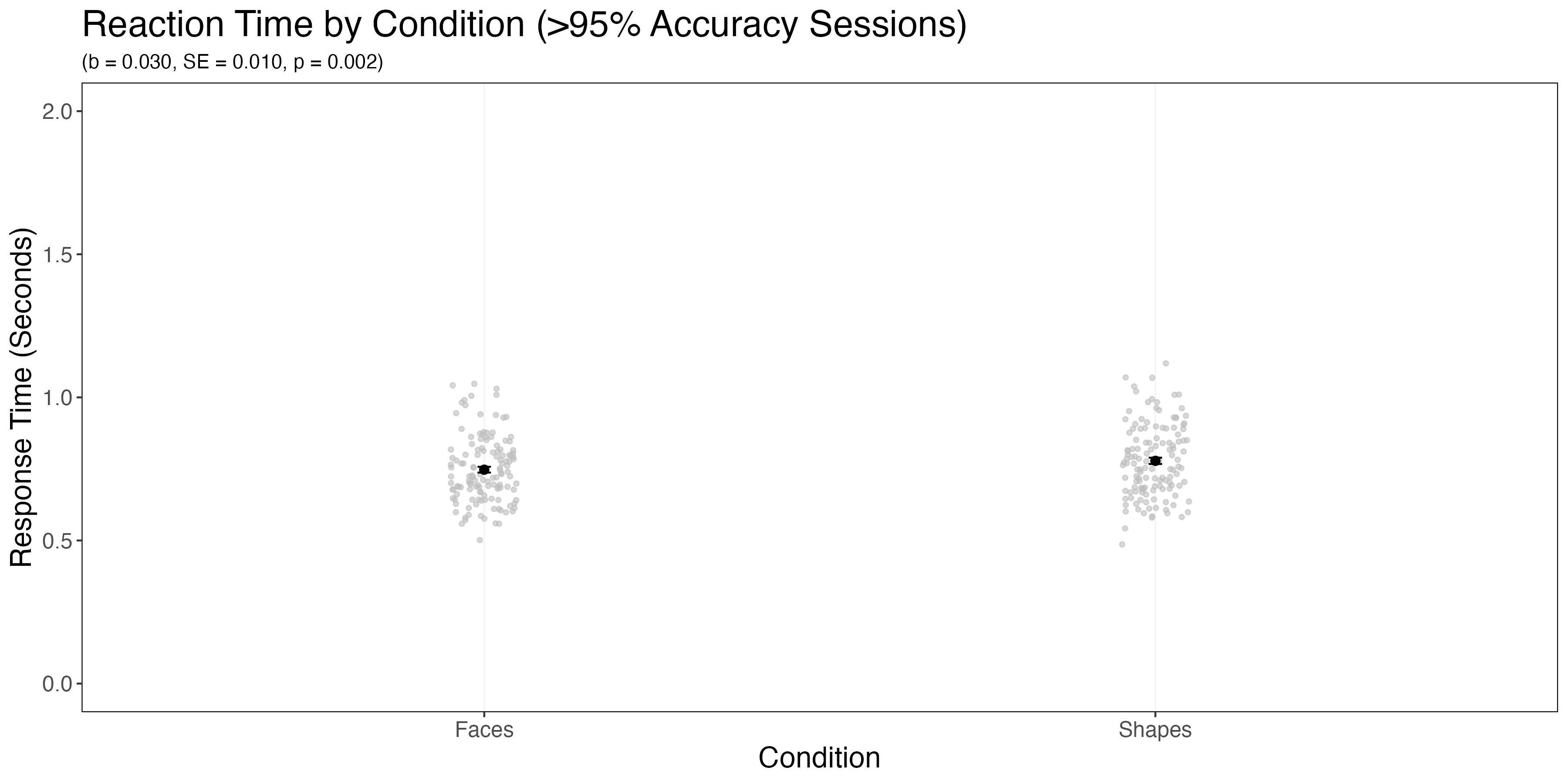
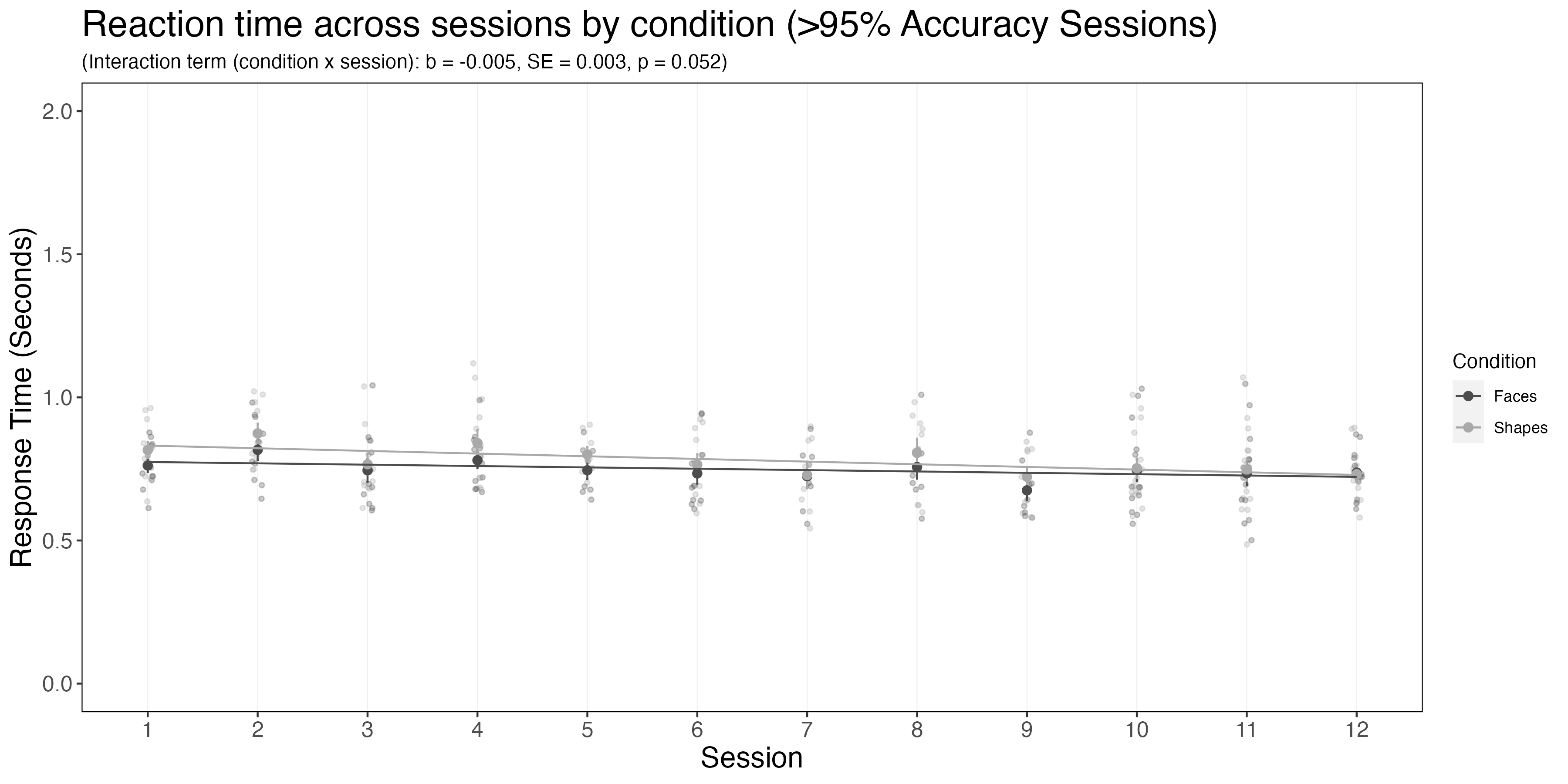
Subjects were given 2.0 seconds to make a response during the task. The average response time across all subjects, for session in which accuracy was greater than 95%, was 0.8 seconds. There was a significant decrease in response time across the sessions (b = -0.0006, SE = 0.002, p = 0.002) and subjects responded faster to the faces condition relative to the shapes condition (b = 0.030, SE = 0.010, p = 0.002). Though there were difference in response time across the two conditions, we have elected to examine the effect of average response time, as interpretations are clearer.
Associations Between Activity and Response Time
[INSERT IMAGE HERE]
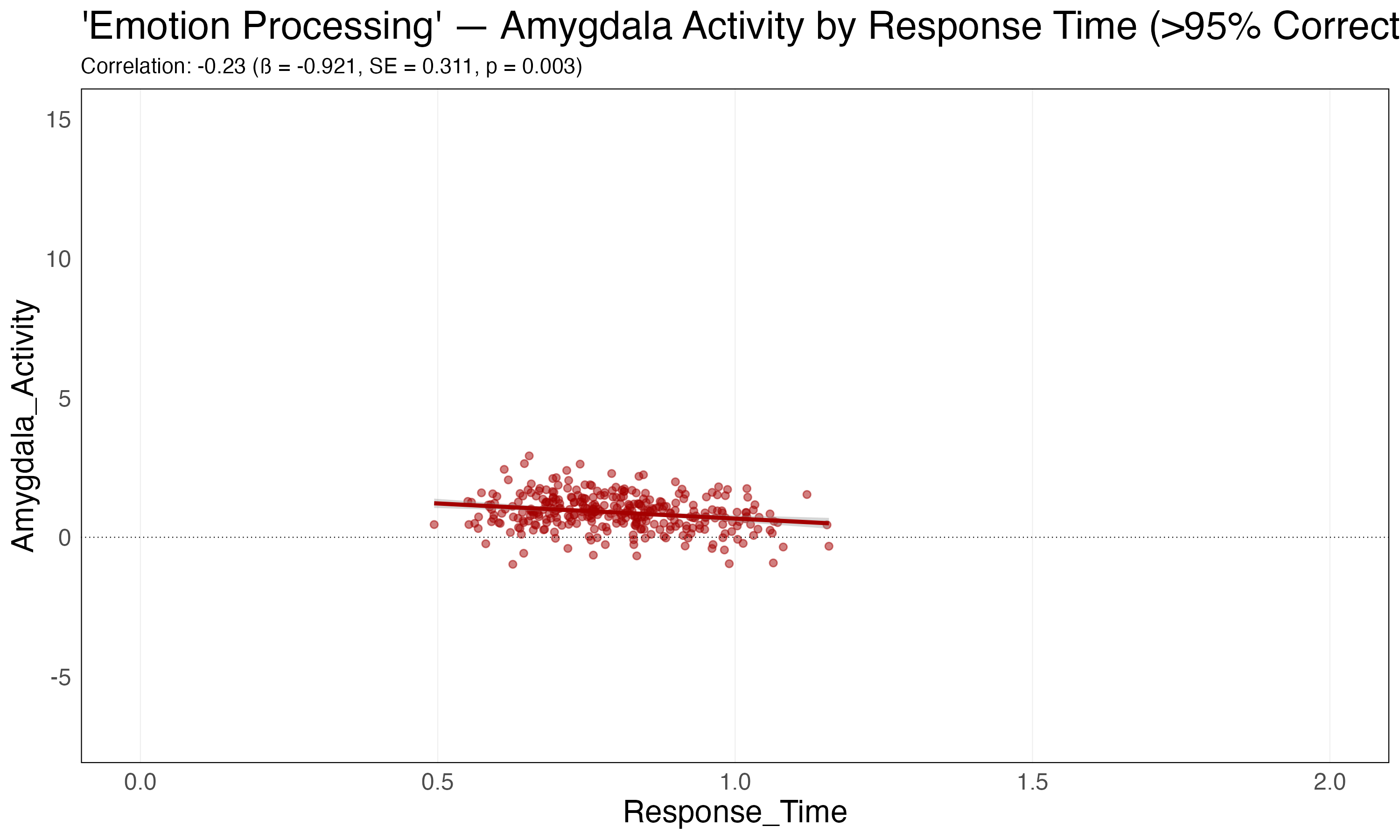

Amygdala. Amygdala activity was negatively associated with response time, such that faster response time was associated with higher activity (b = -0.92, SE = 0.31, p = 0.0003)
Left and Right Fusiform. Both right and left fusiform activity was negatively associated with response time, such that faster response time was associated with higher activity (right fusiform: b = -2.7, SE = 0.76, p < 0.001, left fusiform: b = -3.6, SE = 0.85, p < 0.001). Importantly, the response time effect within the right fusiform was notably stronger than in the left fusiform.
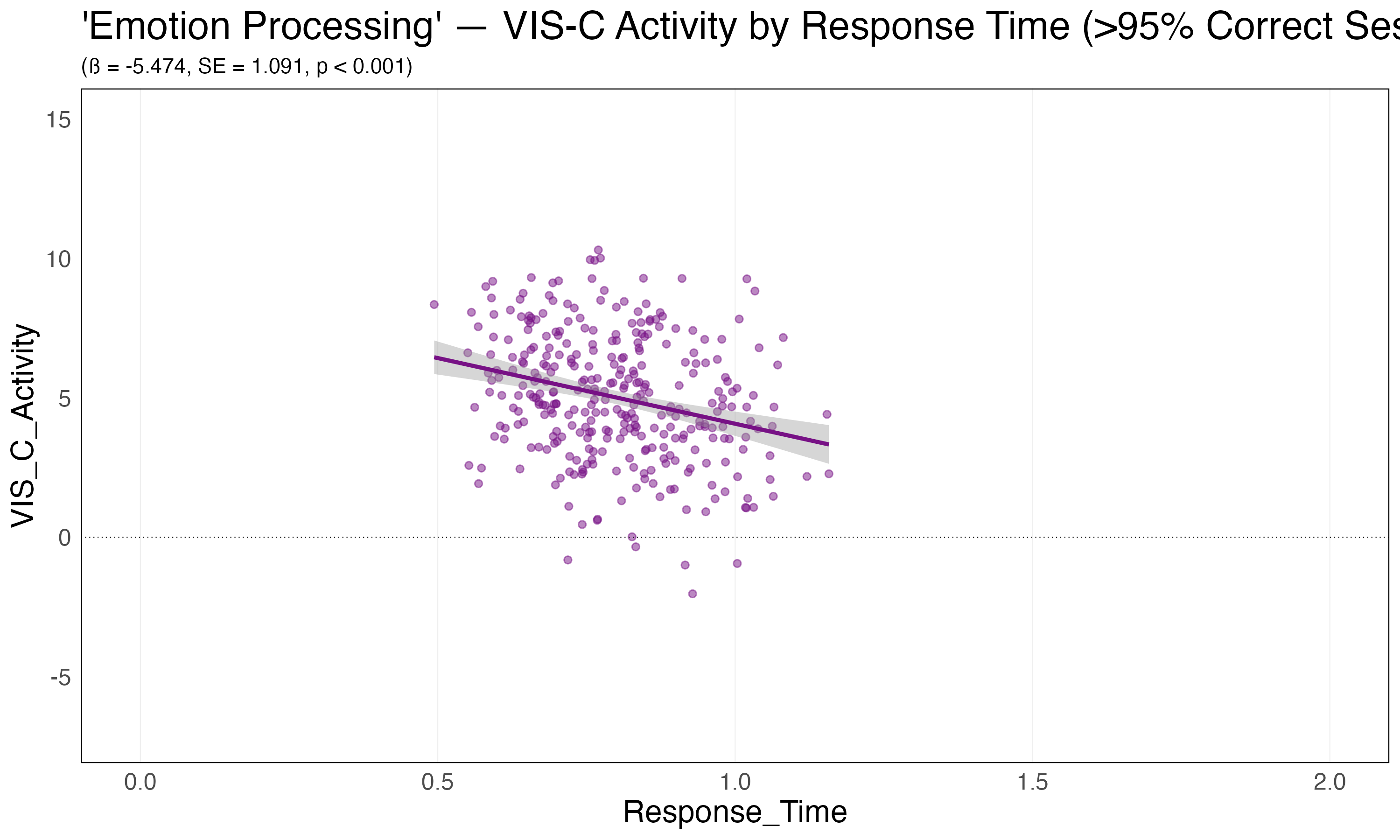
Visual-Central Network (VIS-C). Visual-central network (VIS-C) activity also exhibited significant negative association with response time (b = -5.5, SE = 1.091, p < 0.001).
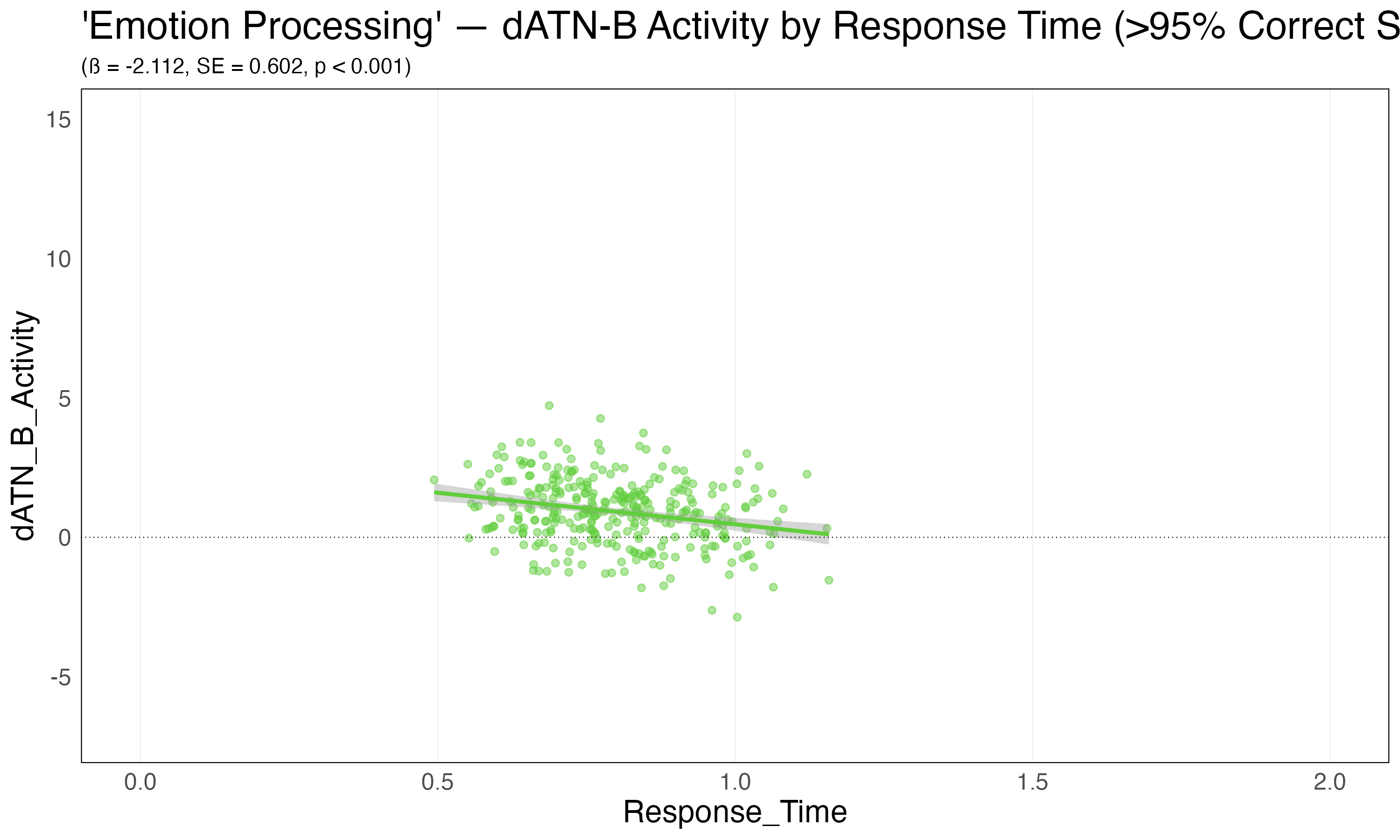
Dorsal Attention Network B (dATN-B). Dorsal attention network B (dATN-B) activity also exhibited significant negative association with response time (b = -2.1, SE = 0.60, p < 0.001).
In sum, all the boundaries show significant negative associations with response time, where by faster responses were associated with higher activity. These findings suggest that the faster subjects respond, the more differentiated the contrast activity (ie. the ‘emotion processing’ activity) is between the faces condition and the shapes condition.
Section 2. Associations with Age
As described in the study description section, the sample consisted of 30 subjects ages 12-17 who each completed 12 sessions of the study.
Age at Baseline: The age of subjects when they first initiated the study. Subjects had aged one year once they had completed all 12 sessions of the study. We will not examine within subject age effects in this analysis, as they will likely be conflated with other time-related effects such as learning and habituation.
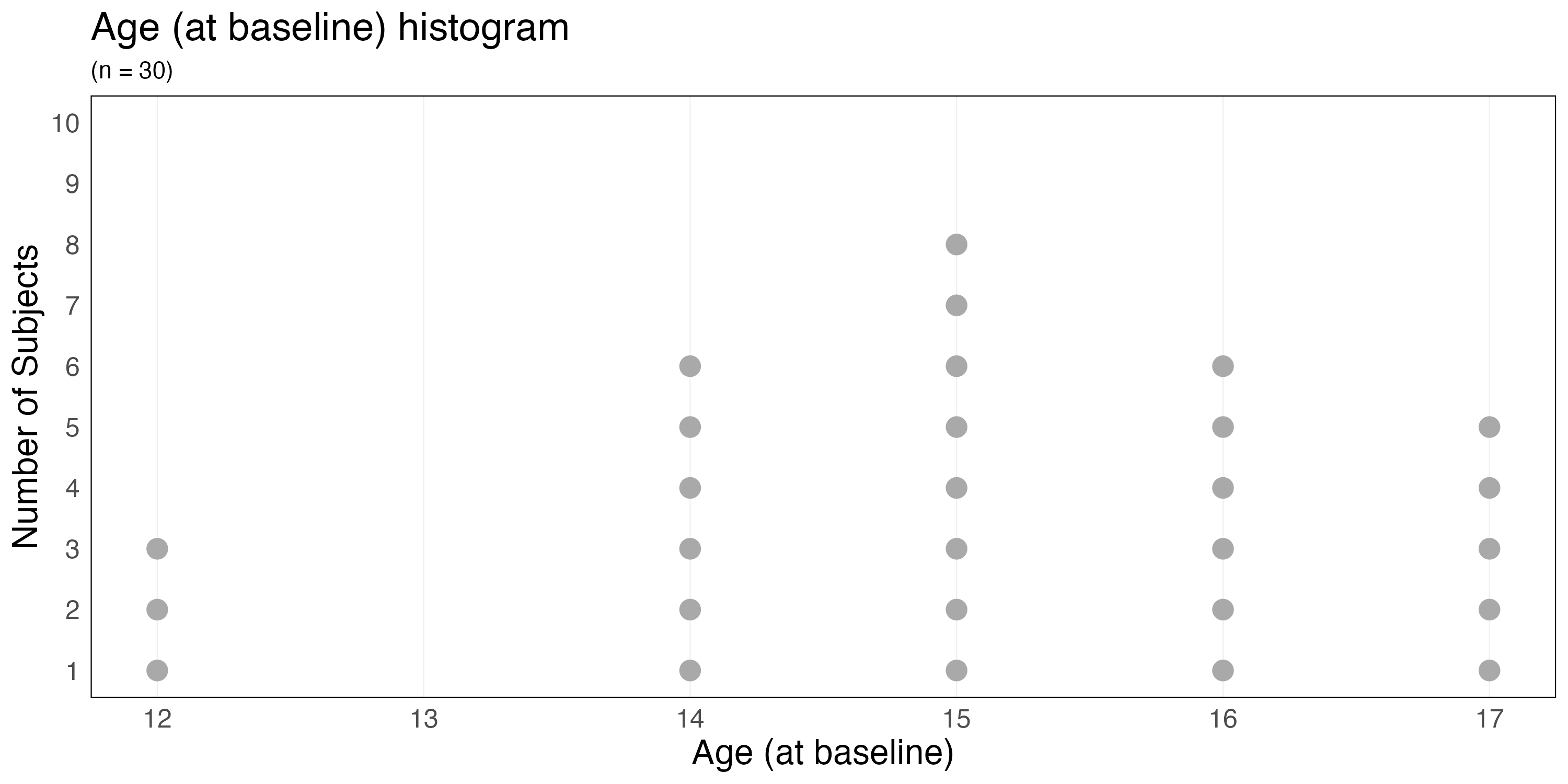
It is important to note that we do not have a uniform distribution of age in the present sample. All the the subjects (with the exception of 3) are between the ages of 14 and 17. We therefor only have a tight age range to examine, which may limit our ability to observe age effects.
Associations Between Age and Task Performance
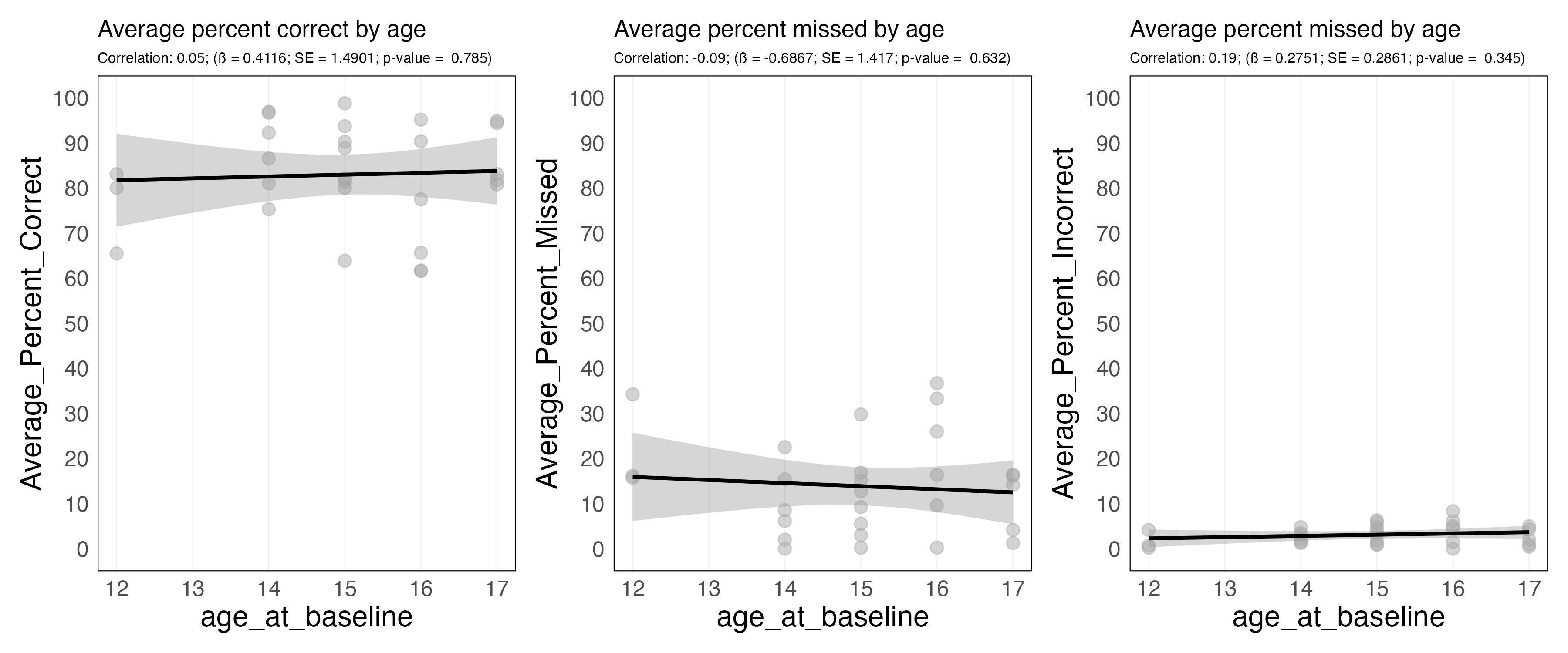
Does average task accuracy vary as a function of age?
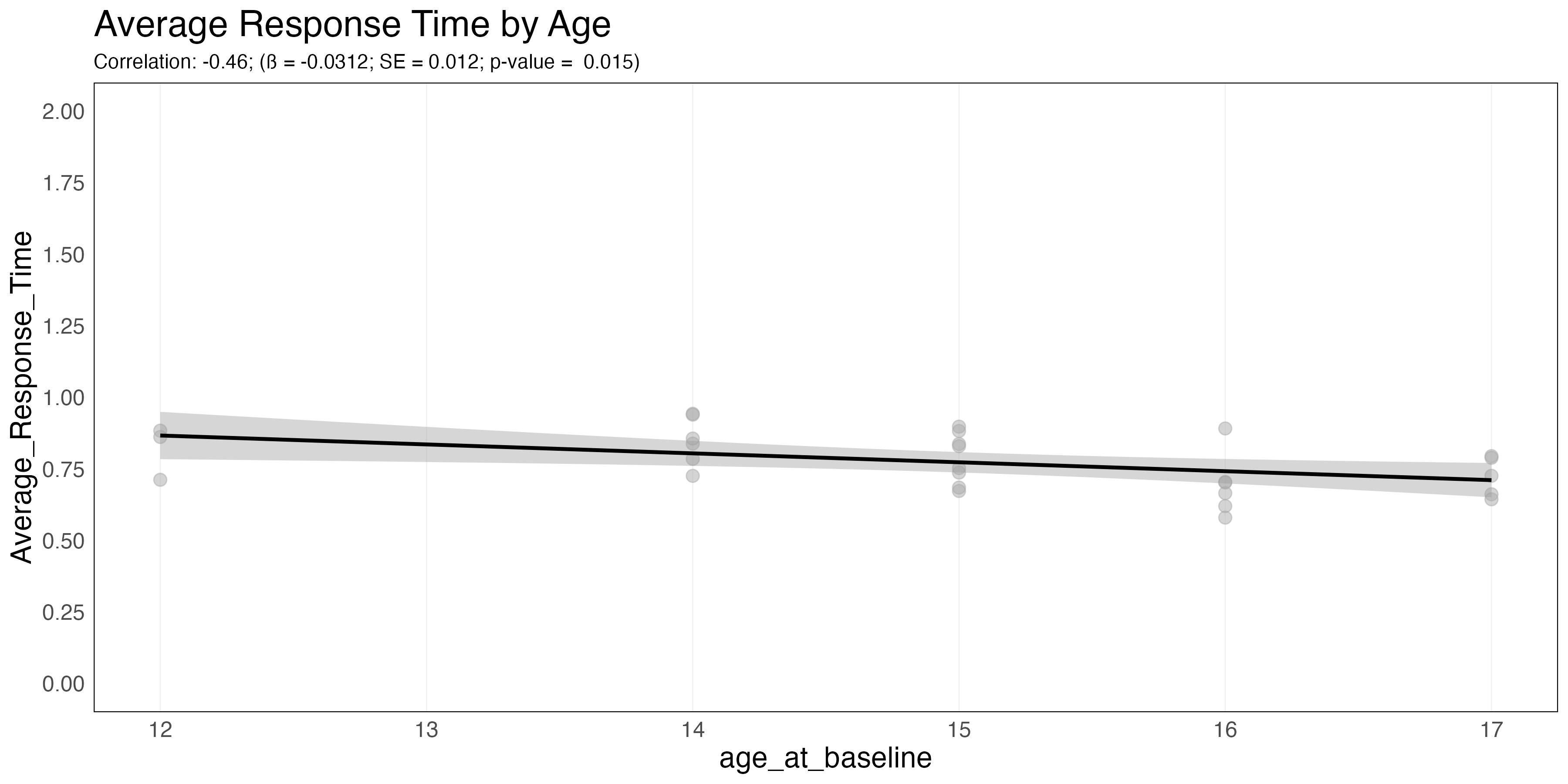
Does average response time vary as a function of age?
Effect of Age on Emotion Processing Activity
[INSERT IMAGE HERE]
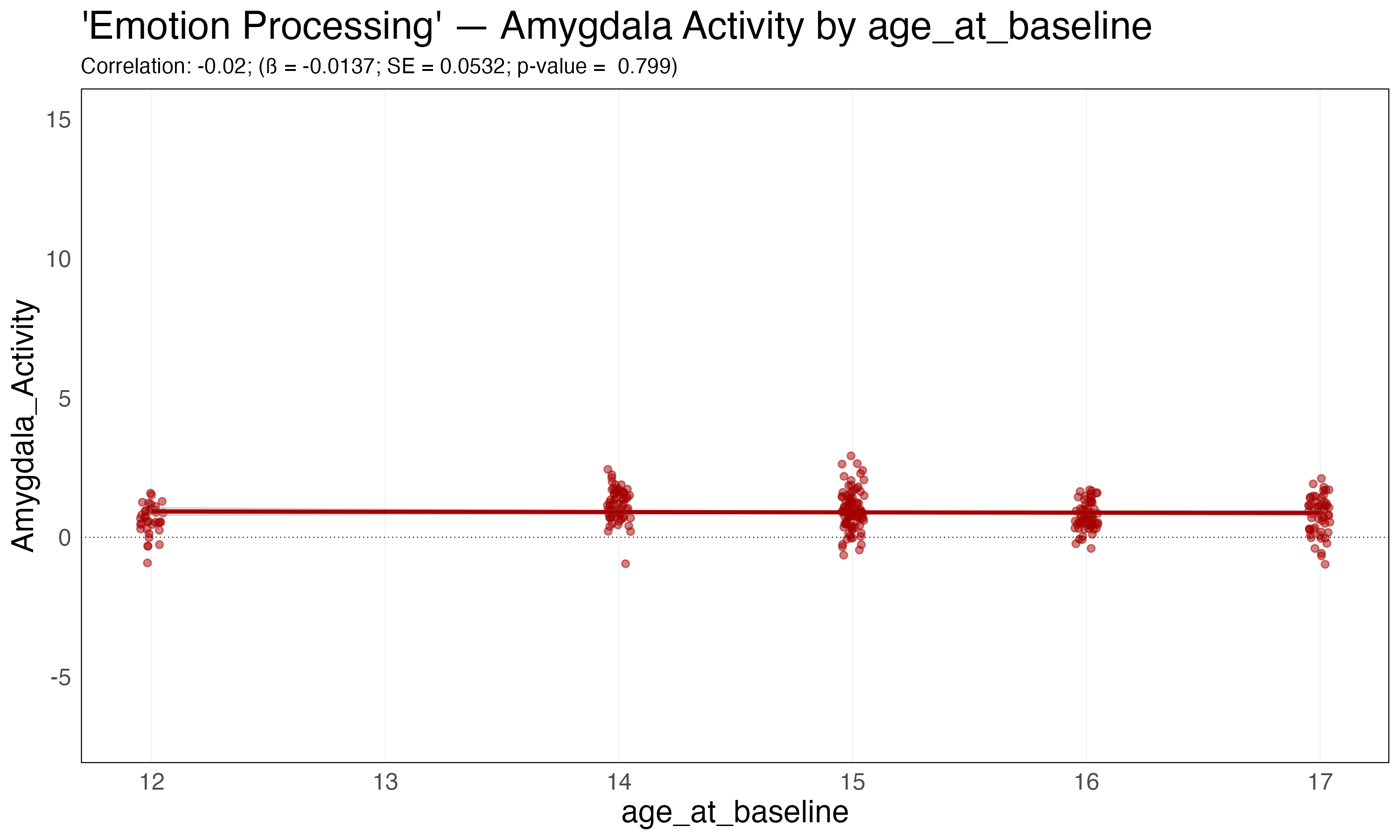

Amygdala. There was no significant effect of age on “emotion processing’ activity within the Amygdala (b = -0.014, SE = 0.053, p = 0.980)
Left and Right Fusiform. There was no significant effect of age on ‘emotion processing’ activity within the right or left fusiform (right fusiform: b = 1.9 , SE = 0.30 , p = 0.537, left fusiform: b = -0.21, SE = 0.17, p = 0.24).
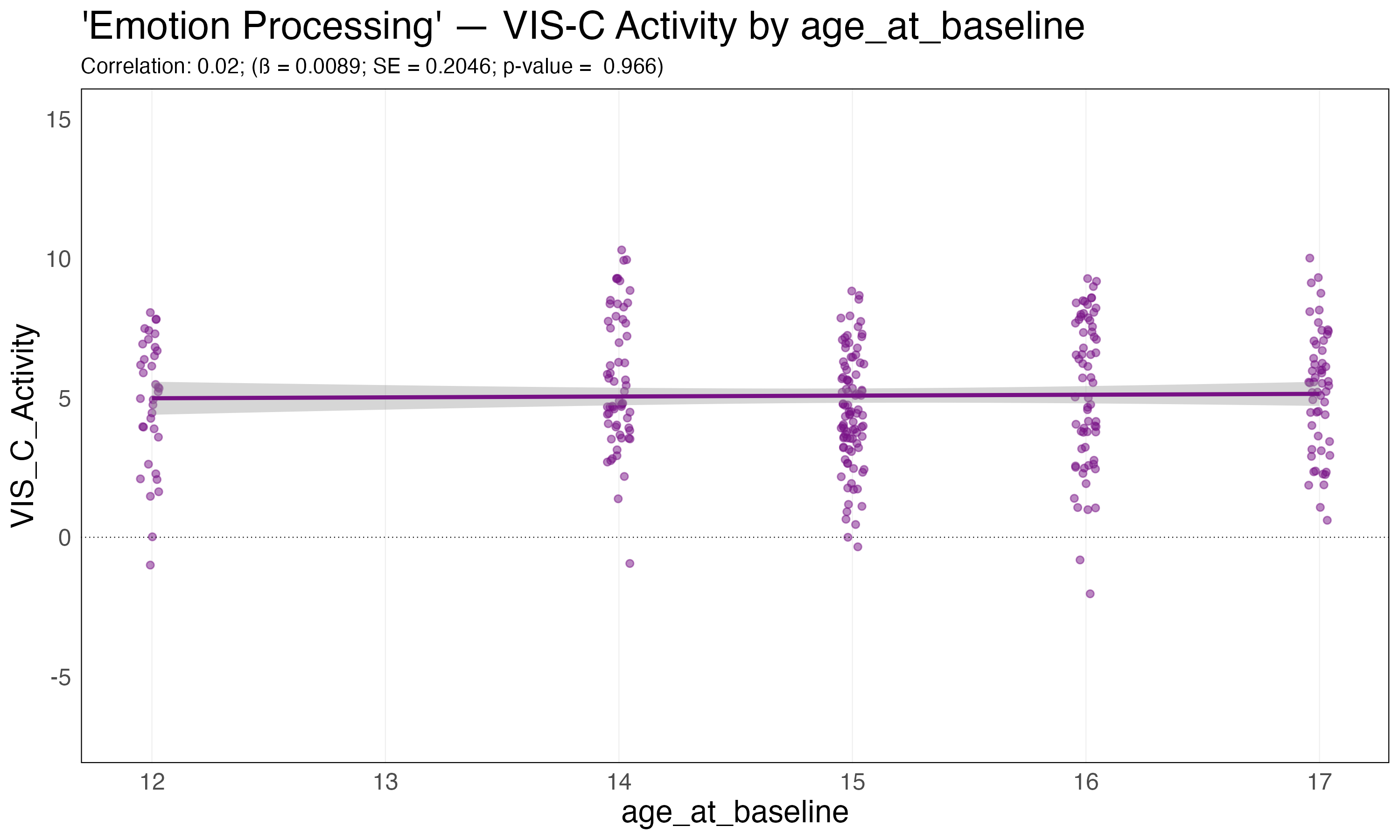
Visual-Central Network (VIS-C). There was no significant effect of age on “emotion processing’ activity within visual-central network (VIS-C) (b = 0.0089, SE = 0.20, p = 0.97).
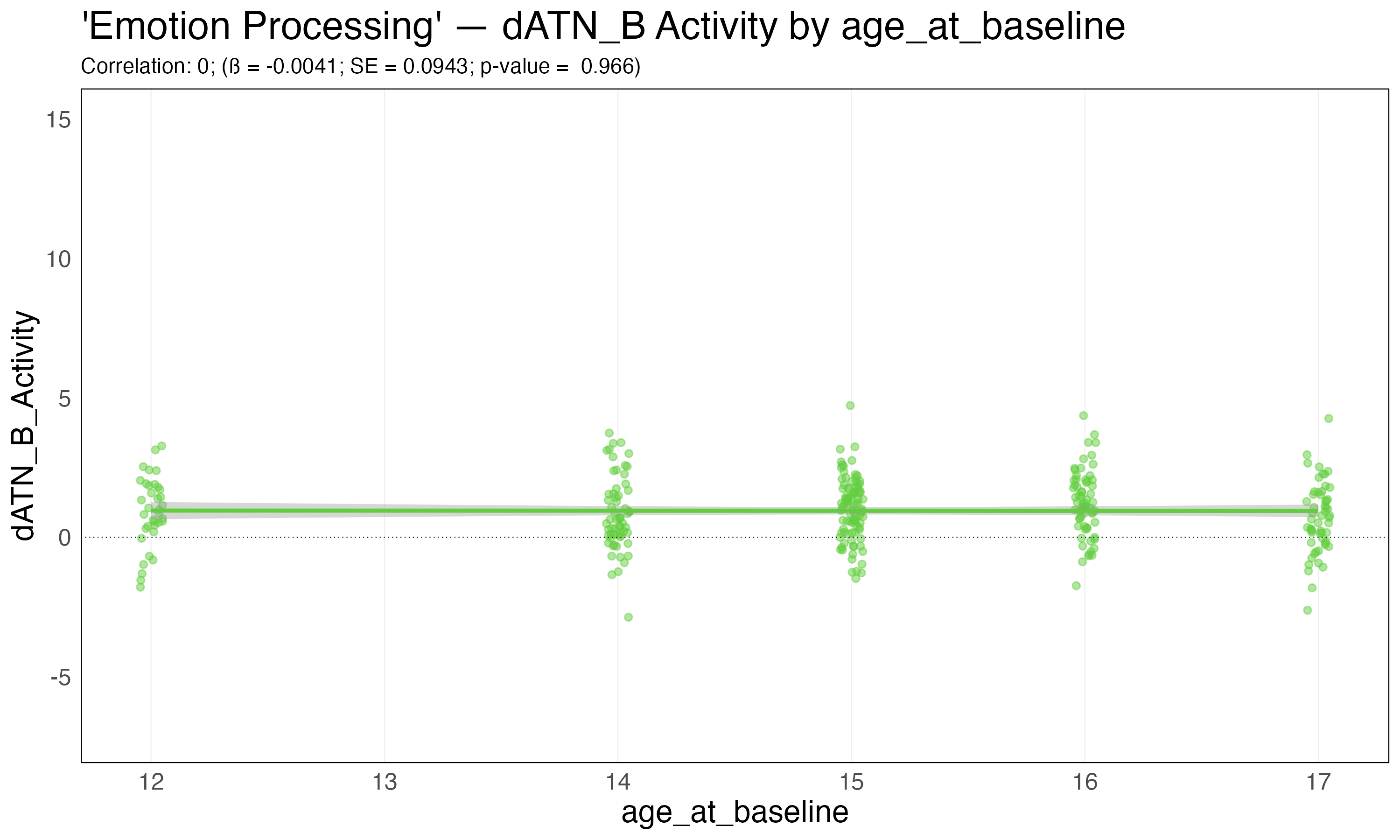
Dorsal Attention Network B (dATN-B). There was no significant effect of age on “emotion processing’ activity within dorsal attention network B (dATN-B) (b = -0.0041, SE = 0.094, p = 0.97)
In sum, there was no significant effect of age on emotion processing activity within the target boundaries identified. The lack of age related associations suggests that response time effects observed in section 1 are not simply due to developmental differences, despite there being significant effects of age on response time.
In sum, all the boundaries show significant negative associations with response time, where by faster responses were associated with higher activity. These findings suggest that the faster subjects respond, the more differentiated the contrast activity (ie. the ‘emotion processing’ activity) is between the faces condition and the shapes condition.